
Major Breakthrough! China’s First Injectable Silk Fibroin Gel Enters Clinical Trials
December 17, 2025
Source: drugdu
 323
323
 On December 15, 2025, the clinical trial initiation meeting for the injectable silk fibroin gel, led by Director Zhao Hongyi, Chairman of the Plastic and Aesthetic Branch of the China Medical Device Industry Association, was launched at Beijing Hospital of Traditional Chinese Medicine affiliated with Capital Medical University. This study, initiated by Venusilk, is China's first prospective, multicenter, randomized, positive parallel-controlled, evaluator-blinded, non-inferiority clinical trial for an injectable silk fibroin gel. It is primarily designed to validate the safety and efficacy of the filler injectable silk fibroin gel in correcting dynamic forehead wrinkles (forehead lines). The trial will be conducted simultaneously across five clinical trial centers nationwide.
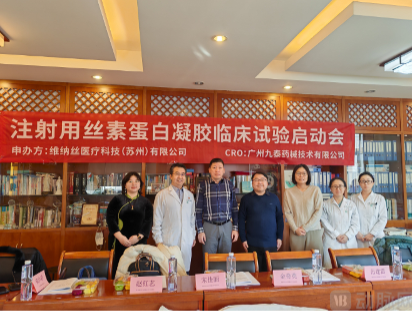 (Injection Silk Fibroin Gel Clinical Trial Initiation Meeting, On-site Photos)
The initiation of this trial marks the entry of China's first injectable silk fibroin gel into a new phase, bringing it closer to regulatory approval and future clinical availability, thereby accelerating patient access to this innovative treatment.
The medical aesthetics materials market is undergoing a seismic shift.
According to the Blue Book on the Development Status and Future Trends of Medical Aesthetic Injectable Products 2025 released by Frost & Sullivan, the retail market size for medical aesthetic injectables in China has grown from RMB 25.7 billion in 2018 to RMB 67 billion in 2023, achieving a compound annual growth rate (CAGR) of 21.1%. It is projected to reach RMB 147 billion by 2027, with a CAGR of 21.7%.
In this multi-billion-yuan market, hyaluronic acid, botulinum toxin, collagen, and regenerative materials currently dominate the majority of market share as the four primary materials. However, with industry advancement and technological breakthroughs, the dominance of these materials is being challenged. New materials like silk fibroin are steadily disrupting the status quo with their differentiated advantages.
As the earliest injectable material to be applied on a large scale, hyaluronic acid (HA) remains the mainstream filler in medical aesthetics. Yet, its limitations are becoming increasingly recognized: post-injection HA can lead to localized temporary edema, residual crosslinking agents, and even complications like the Tyndall effect (a bluish or translucent appearance of the skin) or a "puffy face" sensation due to overfilling.
Botulinum toxin is another major product, valued for its minimal invasiveness, rapid results, and wide applications. However, it faces challenges such as short duration of effect (3–6 months) and high long-term costs. Potential side effects include facial stiffness, brow ptosis, limited brow movement, and eyelid drooping.
Recently popularized collagen-based and regenerative materials also present various issues. For instance, animal-derived collagen suffers from low yield and high costs; recombinant collagen has limited structural integrity, difficulty achieving full-length molecules, and poor supportive properties; regenerative materials like PLLA and PCL cannot precisely control the regenerative stimulation effect and are prone to side effects like granuloma formation and nodular overstimulation.
To address the rapidly growing medical aesthetic filler market and its unmet needs, numerous innovative companies and listed firms are actively developing safer and more effective new materials, aiming to capture a significant share of the multi-billion-yuan market. Among them, Venusilk has chosen silk fibroin as its breakthrough solution.
Silk fibroin is a natural polymer extracted from silk, containing 18 amino acids also found in the human body, primarily glycine, alanine, and serine. This composition grants silk fibroin unique bioactivity and application potential, including excellent biocompatibility, low immunogenicity, and properties that promote cell proliferation. It effectively reduces postoperative infection risks, and its degradation products are amino acids that the body can naturally metabolize, offering significantly superior safety compared to some traditional materials.
Furthermore, silk fibroin possesses outstanding mechanical and physicochemical properties, such as exceptional flexibility, tensile strength, breathability, moisture permeability, and sustained-release capabilities.
Given these superior properties, silk fibroin is considered a potential breakout star for the next generation of medical aesthetic materials. Currently, several innovative companies are exploring composite gels combining silk fibroin with hyaluronic acid (HA). Compared to traditional HA-only crosslinked gels, the silk fibroin-sodium hyaluronate (HA) composite gel can promote the gelation of large HA molecules, slow their degradation rate, optimize filling effects, and prolong efficacy duration.
However, such products still fail to address the issue of residual crosslinkers from HA and cannot fully leverage the excellent mechanical properties of silk fibroin.
To address industry pain points, Venusilk has launched China’s first injectable silk fibroin gel.
It is reported that this injectable silk fibroin gel utilizes Venusilk’s proprietary technology to induce a conformational change in the silk fibroin protein, enabling it to self-assemble into a biomimetic Voronoi nanonetwork structure. This structure mimics the highly efficient arrangement of cells found in nature, providing immediate support to the skin while promoting long-term collagen regeneration, thereby achieving the dual effects of “instant filling + sustained regeneration.”
Notably, this innovative technology allows Venusilk to produce a pure silk fibroin gel with structural support without the need for crosslinking agents, effectively avoiding issues associated with traditional filler materials, such as crosslinker residue, the Tyndall effect, and high swelling rates.
Compared to silk fibroin-hyaluronic acid composite gels on the market, Venusilk’s silk fibroin gel is a pure silk fibroin product with a single composition. This allows it to fully leverage the material advantages of silk fibroin while achieving effective support and guided regeneration.
The breakthrough in developing China’s first injectable silk fibroin gel is attributed to Venusilk’s strong R&D team and capabilities. For instance, Dr. Gong Zuguang, founder of Venusilk, studied under Professor Shao Zhengzhong and has long been dedicated to research on silk fibroin medical hydrogels, with nearly two decades of experience in the R&D and industrialization of biomedical materials.
Venusilk has also established collaborations with top universities such as Southwest University and Fudan University. Among them, Professor Xia Qingyou from Southwest University serves as the Director of the State Key Laboratory of Silkworm Genome Biology and was a key contributor to China’s silkworm genome project. The Biomacromolecules Research Group at Fudan University is a leading laboratory in China for silk fibroin material research.
Supported by robust R&D capabilities, Venusilk has built a systematic intellectual property barrier around pure silk fibroin gel materials, completing a comprehensive patent portfolio spanning raw material processing, core formulations, and preparation processes. This lays a solid foundation for its technology commercialization and market competitiveness.
With the initiation of this clinical trial, the safety, efficacy, and clinical value of the injectable silk fibroin gel are expected to be validated. If the trial proceeds smoothly, the product could soon receive regulatory approval, offering safer and more effective solutions for beauty seekers in China.
In the field of medical aesthetic materials, the industry consistently pursues: higher safety and lower adverse reaction rates; addressing the “puffy face” phenomenon to achieve better shaping effects; flexibly meeting filling needs for different areas; and exploring more diverse functions, such as tissue repair, anti-inflammation, and anti-oxidation. Therefore, the injectable silk fibroin gel—with its higher safety, lower adverse reaction rates, and avoidance of crosslinker residue, the Tyndall effect, and high swelling rates—holds the potential to become the next breakthrough product in medical aesthetic materials.
Reference:https://bydrug.pharmcube.com/news/detail/f29721500f85cc71767731a554cac2e4
Copyright©2026 Ddu. All rights reserved.
Read more on
- FDA Approves Revolution Medicines’ Oral RAS Inhibitor Rasonque (daraxonrasib) for Metastatic Pancreatic Cancer October 20, 2026
- Hansoh Pharma Enters Strategic ADC Collaboration with Roche Worth Over US$15.5 Billion October 20, 2026
- New cough medicine launched October 20, 2026
- Shining on the top stage! The world’s first three-target agonist DR10624 MASLD/MASH Phase II results were selected for the latest breakthrough abstract of AASLD. October 20, 2026
- The world’s first long-acting anti-RSV monoclonal antibody has been commercially launched October 20, 2026
your submission has already been received.
OK
Subscribe
Please enter a valid Email address!
Submit
The most relevant industry news & insight will be sent to you every two weeks.