
Cell Metabolism | Efficacy of Akkermansia muciniphila Supplementation in Overweight/Obese Patients with Type 2 Diabetes
December 17, 2025
Source: drugdu
 424
424
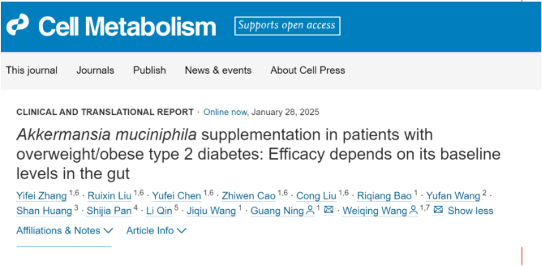
On January 28, 2025, Cell Metabolism (IF=27.7) published online a research report titled“Supplementation with Akkermansia muciniphila in Overweight/Obese Patients with Type 2 Diabetes: Efficacy Depends on Its Baseline Abundance in the Gut.”
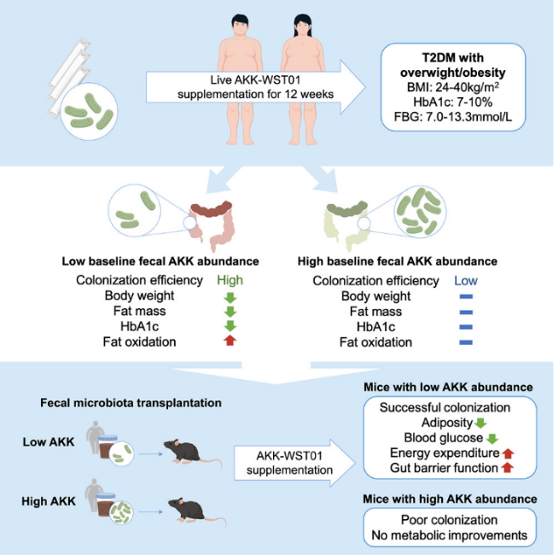
 This study employed a combined approach of multicenter clinical intervention research and animal experiments to reveal for the first time that the efficacy of Akkermansia muciniphila (abbreviated as AKK) in clinical weight loss and glucose lowering largely depends on the individual's baseline abundance of AKK bacteria in the gut. The study found that supplementation with AKK demonstrated significant metabolic improvement only in patients with low baseline AKK abundance in their intestines.
This breakthrough discovery moves beyond the "one-size-fits-all" model of probiotic supplementation, proposing a "supplement only if deficient" philosophy for precise probiotic use. It provides a key example of precision probiotic intervention based on individual gut microbiota ecology and is expected to advance the development of personalized probiotic treatment strategies.
 Obesity and diabetes have become major global public health challenges. Gut microbiota plays a crucial role in regulating host health and energy metabolism, and dysbiosis is closely associated with the development of obesity and diabetes. Previous studies have shown that Akkermansia muciniphila (AKK) is considered a next-generation functional probiotic with significant application potential due to its potential metabolic regulatory effects.
Obesity and type 2 diabetes (T2D) are critical public health issues worldwide. The gut microbiota is vital in regulating host health and energy metabolism, and its dysbiosis is closely linked to obesity and T2D. In recent years, A. muciniphila (AKK) has been regarded as a promising next-generation functional probiotic due to its potential metabolic benefits.
AKK is a symbiotic bacterium colonizing the intestinal mucus layer, accounting for 1%–5% of the total gut microbiota. Studies have shown that reduced AKK levels are closely associated with obesity and diabetes, while animal experiments confirm that AKK supplementation can improve body weight, glucose metabolism, and intestinal barrier function in mice. However, clinical evidence for AKK application remains insufficient, particularly regarding which patients would benefit more from AKK supplementation.
The research team conducted a randomized controlled multicenter clinical intervention study on a novel AKK strain—AKK-WST01, previously isolated from healthy Chinese individuals. This study revealed for the first time that the clinical efficacy of AKK supplementation in weight loss and glucose control largely depends on the individual’s baseline AKK abundance in the gut. Metabolic benefits were observed only in subjects with low baseline AKK levels, providing critical evidence for precision medicine interventions based on individual gut microbiota.
In this study, the team first conducted a 12-week randomized, double-blind, placebo-controlled multicenter clinical intervention. A total of 58 overweight or obese T2D patients from four centers were randomly assigned to receive either AKK-WST01 supplementation or a placebo. After 12 weeks, supplementation with AKK-WST01 showed high colonization rates only in patients with low baseline AKK levels, significantly increasing post-intervention AKK abundance and improving body weight, visceral fat, glucose, and lipid metabolism. Using metabolic chamber technology for precise energy metabolism assessment, researchers also found that fat oxidation significantly increased in these low-baseline AKK patients after supplementation. However, in patients with relatively high baseline AKK levels, AKK-WST01 supplementation neither further increased their gut AKK abundance nor demonstrated significant metabolic improvements.
This suggests that the metabolic benefits of AKK-WST01 supplementation are closely linked to the baseline abundance of AKK in the gut.
To further validate this clinical finding, the team transplanted fecal samples from two subjects with low and high baseline AKK levels into germ-free mice, followed by control or AKK-WST01 supplementation. The results showed that only in mice with low baseline AKK levels did AKK-WST01 supplementation effectively colonize and ameliorate high-fat diet-induced weight gain, metabolic disorders, and intestinal barrier dysfunction. Additionally, AKK-WST01 supplementation significantly reduced circulating lipopolysaccharide (LPS) levels and decreased inflammatory cytokine expression in the low-baseline group.
In summary, this study, through parallel validation in clinical interventions and animal experiments, reveals that the efficacy of AKK-WST01 supplementation is closely tied to the host’s baseline AKK abundance in the gut. It proposes and confirms a novel concept of “personalized and precise probiotic supplementation guided by baseline gut microbiota levels.” This finding offers new insights into regulating metabolic diseases through gut microbiota and lays the foundation for developing personalized probiotic intervention strategies.
Reference: https://bydrug.pharmcube.com/news/detail/46fb6e7e10f2dcefdea051ce778b3424
By editor
Copyright©2026 Ddu. All rights reserved.
Read more on
- FDA Approves Revolution Medicines’ Oral RAS Inhibitor Rasonque (daraxonrasib) for Metastatic Pancreatic Cancer October 20, 2026
- Hansoh Pharma Enters Strategic ADC Collaboration with Roche Worth Over US$15.5 Billion October 20, 2026
- New cough medicine launched October 20, 2026
- Shining on the top stage! The world’s first three-target agonist DR10624 MASLD/MASH Phase II results were selected for the latest breakthrough abstract of AASLD. October 20, 2026
- The world’s first long-acting anti-RSV monoclonal antibody has been commercially launched October 20, 2026
your submission has already been received.
OK
Subscribe
Please enter a valid Email address!
Submit
The most relevant industry news & insight will be sent to you every two weeks.


