
Huarun to Part Ways with Hefei Tianmai Biotech at a Valuation of 1.93 Billion Yuan
March 20, 2026
Source: drugdu
 270
270
From an aggressive M&A spree to a now selective asset manager, China Resources Pharmaceutical has begun to shift its logic in selecting and exiting investment targets.
01
Ending a Decade-Long Partnership
China Resources Pharmaceutical Continues Asset Divestment
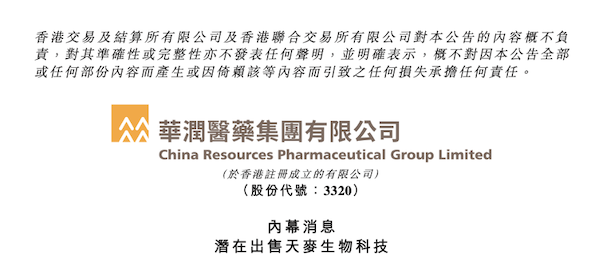
On March 16, China Resources Pharmaceutical announced a plan to sell a 5.88% equity stake in Hefei Tianmai Biotech Co., Ltd. (“Tianmai Biotech”) via public listing at a price of 510 million yuan.
This marks the second disposal of Tianmai Biotech shares by China Resources Pharmaceutical in just over a month. In February this year, it put a 17.87% stake up for transfer at a reserve price of 1.42 billion yuan. The combined reserve prices of the two transactions total 1.93 billion yuan, and the two deals are independent of each other.
Data from Qichacha shows that China Resources Pharmaceutical Investment, a wholly-owned subsidiary of China Resources Pharmaceutical, is the largest shareholder of Tianmai Biotech, holding 20% directly. With an additional 3.75% indirect stake, the China Resources group holds a total of 23.75% of Tianmai Biotech. Upon completion of the two listed transactions, the China Resources group will fully exit Tianmai Biotech, bringing an end to its nearly decade-long strategic investment.
 Source: Qichacha
Founded nearly 16 years ago, Tianmai Biotech focuses its core products on insulin therapies. Its partnership with China Resources Pharmaceutical dates back to 2016, when China Resources Pharmaceutical bet on its product and technological prospects, signing an agreement to develop recombinant human insulin and related technology platforms.
In terms of product portfolio, all of Tianmai Biotech’s approved marketed products are biosimilars covering second- and third-generation insulins. Among them, Human Insulin Injection (3ml:300 units (cartridge)*1), Isophane Human Insulin Injection (3ml:300 units (cartridge)*1), and Biphasic Isophane Human Insulin Injection (30R) (3ml:300 units (cartridge)*1) have all been selected in the national insulin bulk procurement and its follow-up special procurement.
What also drew China Resources Pharmaceutical to the partnership was the future potential of recombinant human insulin enteric-coated capsules (ORMD-0801), an oral insulin developed by Tianmai Biotech using technology introduced from Oramed Ltd. of Israel.
Compared with traditional injectable insulin, oral insulin eliminates the need for injection, which can significantly lower the barrier to patient access and improve medication adherence. It boasted strong competitiveness in the 10-billion-yuan insulin and analog market, which was the core reason Tianmai Biotech was once highly sought after by capital.
However, this promising vision came to an abrupt halt in December 2025, when the National Medical Products Administration (NMPA) issued a notice rejecting the marketing application of ORMD-0801 filed by Tianhui Biotech, an affiliated company of Tianmai Biotech. The innovation story that underpinned its high valuation was thus broken.
02
Splitting Stake into Two Listings
Multiple Factors Drive the Exit Decision
In fact, China Resources Pharmaceutical’s exit is not solely due to the failure of Tianmai Biotech’s core innovative project, but also a combination of valuation contraction, industry cutthroat competition, and its own strategic realignment.
Tianmai Biotech once enjoyed a high valuation of over 10 billion yuan. Prior to China Resources Pharmaceutical’s investment, Yuheng Pharmaceutical planned to acquire no less than 35% of its equity for no less than 4 billion yuan, implying a valuation exceeding 10 billion yuan. Based on the two current listing prices, Tianmai Biotech’s overall valuation is approximately 8 billion yuan, marking a notable decline from its peak.
More critically, the listing period for the first 17.87% stake expired on March 13, yet no transferee information has been disclosed to date.
By splitting the stake into two independent listings, China Resources Pharmaceutical aims to lower the entry barrier for potential buyers, accelerate capital recovery, and stop losses in a timely manner.
Meanwhile, the domestic traditional insulin market has become fiercely competitive, squeezing Tianmai Biotech’s growth potential. According to MENET data, in 2024, the market size of insulin and its analogs (chemical + biological) across China’s three major terminals and six markets exceeded 18 billion yuan, but the market structure has become largely consolidated. Novo Nordisk, Sanofi, and Gan & Lee Pharmaceuticals rank among the top three, accounting for over 70% combined. Latecomers like Tianmai Biotech face difficulties in breaking through, with narrowing profit margins.
For China Resources Pharmaceutical, rather than continuing to “drag on,” it has chosen to reallocate resources to more certain tracks and projects, such as the weight management segment through the collaboration between China Resources Sanjiu and Brightgene Bio Tech.
For Tianmai Biotech, with the departure of its major shareholder and setbacks in core product development, its urgent priorities are advancing its pipeline and achieving commercialization.
03
From "Expansion" to "Contraction"
Asset Restructuring
For China Resources Pharmaceutical, a company born and raised on mergers and acquisitions, its past strategy focused predominantly on acquiring promising pharmaceutical projects—such as the blood products business of Boya Bio—aiming to rapidly fill gaps in its portfolio and expand its industrial chain. Today, however, it has shifted from expansion ("doing addition") to contraction ("doing subtraction"), beginning to divest non-core assets and exit inefficient businesses.
Against the overall landscape of CR Healthcare’s listed pharmaceutical platforms, its development trajectory is clear.
First, its core foundation remains solid. Taking China Resources Sanjiu as an example, its 2025 preliminary earnings report shows revenue of 31.629 billion yuan, a year-on-year increase of 14.53%, and net profit attributable to shareholders of 3.422 billion yuan, up 1.60% year-on-year. Amid CR Healthcare’s group-wide contraction, China Resources Sanjiu has become a key pillar of overall performance through continuous business layout optimization and multi-dimensional expansion of its R&D pipeline.
Second, it is continuously optimizing and adjusting its subsidiaries, gradually streamlining operations and focusing on core businesses. For instance, Boya Bio has concentrated on its main blood products business, yet the progress of non-core asset divestment and integration has been affected by multiple factors, leading to short-term performance pressure. Dirui Medical faces dual pressures of intensifying industry competition and internal restructuring, resulting in a year-on-year decline in profitability, requiring subsequent business optimization to improve quality and efficiency.
Third, governance restructuring and the deployment of new growth drivers are advancing in tandem. To date, executive changes have been made at listed companies including Boya Bio and Dirui Medical, leading to more standardized governance. Meanwhile, China Resources Pharmaceutical is also positioning for the future through industrial funds. For example, the China Resources Pharmaceutical Chengdu Industrial Fund, with a scale of 1 billion yuan, has completed registration with the Asset Management Association of China (AMAC). It focuses on key sectors such as chemical innovative drugs, biological drugs, high-end medical devices, and nourishing traditional Chinese medicine, supporting the innovation and incubation of strategic emerging industries.
Amid this ongoing adjustment, who will be the next to be divested? Based on CR Healthcare’s past practices, assets sustaining losses, minority equity projects with low synergy with the core business, and low-margin, non-barrier sectors are likely to be the key targets for subsequent divestment.
As streamlining and focusing on development have become a common strategy among leading pharmaceutical companies, Sinopharm and Shanghai Pharmaceuticals have also begun divesting non-core assets.
Copyright©2026 Ddu. All rights reserved.
Read more on
- What Are Buyers Looking For, and What Are Suppliers Focused On? September 23, 2026
- Novartis acquires Sironax’s blood-brain barrier delivery platform for $125 million September 17, 2026
- IASO Bio’s in vivo CAR-T IASO208 receives FDA clinical trial clearance September 17, 2026
- NMPA accepts marketing registration application for Velsipity domestic manufacturing transfer September 17, 2026
- Ziprasidone mesylate from SSY Group has been approved for registration as an active pharmaceutical ingredient. September 17, 2026
your submission has already been received.
OK
Subscribe
Please enter a valid Email address!
Submit
The most relevant industry news & insight will be sent to you every two weeks.