
Shijiazhuang Pharmaceutical Group’s budesonide enteric-coated capsules approved! This poses a challenge to generic drug manufacturers, weakening the original drug’s competitive advantage.
May 22, 2026
Source: drugdu
 260
260
On May 21, CSPC Pharmaceutical Group announced that its budesonide enteric-coated capsules (4mg) have officially received registration approval from the National Medical Products Administration.
The approval of this drug for treating primary immunoglobulin A nephropathy (IgAN) may seem like just a generic drug, but it could break through the three-year patent protection barrier of the original drug, Everest Medicines' "Nexocon," and completely change the landscape of the domestic IgA nephropathy drug market.
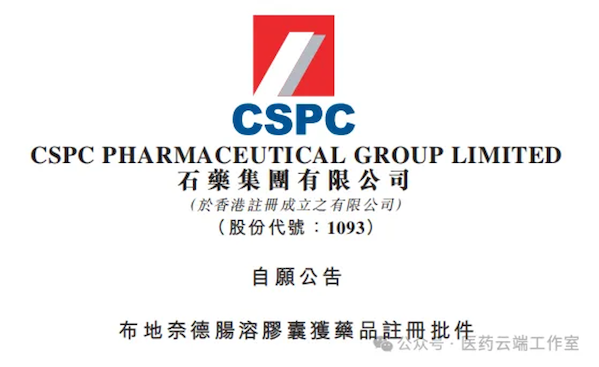 Image source: Shijiazhuang Pharmaceutical Group announcement
As the world's first causal treatment drug for IgA nephropathy, Nefucon has performed brilliantly in the Chinese market since its launch in 2024, with sales reaching 353 million yuan that year. After being included in the national medical insurance program, its market size has further expanded, with sales climbing to 1.44 billion yuan in 2025, becoming a core pillar of the company's revenue.
Supporting the exclusive market rights of this drug is the core formulation patent numbered ZL200980127272.5, which is valid until May 2029. According to the usual pace, the original drug developer could have enjoyed the market benefits exclusively during this period.
The current industry landscape is being gradually disrupted by the trend of generic drug applications, and the different types of declarations under the patent linkage system have become key points of contention among various parties.
Back in December 2025, Hainan Herui's generic drug of the same type had already obtained approval. At that time, the company submitted three declarations, stipulating that it would not be launched on the market before the patent expired, which was a state of approval but not yet put on the market.
Even so, the original research company immediately launched a rights protection action. In February 2026, the relevant court issued a pre-litigation preservation order, requiring Hainan Herui to stop the relevant infringement and online listing activities, which also confirms the industry rule that drug approval does not mean that it can be marketed and distributed.
The changes brought about by Shijiazhuang Pharmaceutical Group's approval this time are even more noteworthy. The company chose to submit a Class 4.2 declaration, claiming that its products do not fall within the scope of original patent protection and that, theoretically, it does not need to wait for the patent to expire and can be put on the market immediately after approval.
Market speculation suggests that the company may have created a technical solution that differs from the patent description by adjusting the formulation and preparation process, such as by changing some excipients or optimizing the microcapsule coating process.
This kind of R&D approach has also appeared in the R&D layout of other domestic companies for the same product. However, at present, there is no publicly available information to confirm the specific technical adjustment details of CSPC Pharmaceutical Group, and the relevant process formula is still undisclosed.
In addition, Qilu Pharmaceutical's generic version of the same drug is also under review with a similar declaration. If it is approved smoothly, it will further intensify the competition in the market.
With the changing market landscape, the operating expectations of original research companies have also been affected, and their original annual sales targets now face considerable uncertainty.
Going forward, companies will likely respond from two fronts: legal rights protection and market awareness. On the one hand, they can assert their rights through legal channels and apply for relevant sales bans. However, in the judgment scenario of Class 4.2 declarations, it is relatively more difficult to prove product infringement.
On the other hand, there have been views within the industry that conventional bioequivalence trials are insufficient to fully verify the actual efficacy differences of intestinal-targeted drugs, and such views may become a point of contention in the market.
In November 2022, the FDA released a draft guidance on bioequivalence of budesonide enteric-coated capsules, which set out the requirements for trial design and testing criteria.
The acceptance of trial data for such targeted formulations has always been a focus of review. Industry insiders speculate that CSPC Pharmaceutical Group may refer to the guidelines in its own trials to enhance the data's reference value and reduce subsequent controversies. However, the company has not yet disclosed its complete trial protocol, making it impossible to determine whether its trial standards align with or exceed relevant regulations. Only reasonable speculation based on industry review trends can be made.
This patent-level competition also reflects the development and transformation of the domestic generic drug industry.
In the past, most pharmaceutical companies waited for patents to expire before launching their products, or competed fiercely for the first generic drug designation. However, this time, the patent challenge initiated with a differentiated technological approach reflects a shift in the industry's R&D thinking. Companies are no longer simply passively waiting for the window of opportunity, but are instead exploring compliant breakthrough paths based on their own R&D capabilities. Their development model has also taken a path that fits the characteristics of the domestic industry.
With the launch of multiple generic drugs, the monopoly of the original drug manufacturer is no longer possible. In the face of competition from multiple companies, price competition is inevitable. For patients, this is expected to reduce medication costs, significantly alleviating the burden of treatment and allowing more patients to access appropriate medications.
https://mp.weixin.qq.com/s/_PCCDQaLC33Y9WgZHfUqEA
Copyright©2026 Ddu. All rights reserved.
Read more on
- CPHI Milan 2026 Recap | What Did Drugdu.com Bring Back from Milan? October 9, 2026
- Novo Nordisk and Nanexa Ink Up to €1.165B Long-Acting Delivery Deal for Obesity and Diabetes September 29, 2026
- siRNA Biotech ADARx Raises $446M in 2026’s Third-Largest Biotech IPO September 29, 2026
- Merck and Eisai’s Welireg Plus Lenvima Approved by FDA for Previously Treated Advanced Kidney Cancer September 29, 2026
- Mirum and Incyte’s Atebrioz Wins FDA Approval for Rare Bone Disorder FOP September 29, 2026
your submission has already been received.
OK
Subscribe
Please enter a valid Email address!
Submit
The most relevant industry news & insight will be sent to you every two weeks.


