
How NMN Helps Longevity Enzymes Fight Aging
August 25, 2025
Source: drugdu
 295
295
Sirtuin enzymes are a family of NAD+-dependent deacetylase proteins, also known as sirtuins, which mediate many of the beneficial effects of NMN on the brain and intestines of aged mice.
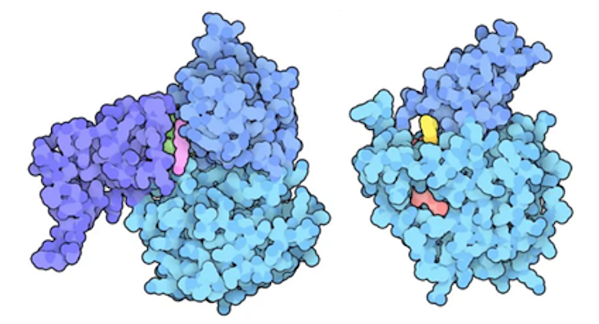 Left: Sirtuin 1 bound to the sirtuin activator resveratrol (magenta). Right: Sirtuin 6 bound to the sirtuin activator (yellow) and NAD+ (red).
Sirtuins act like molecular switches, orchestrating the countless processes necessary for cellular health and longevity. These specialized proteins function as NAD+-dependent deacetylases—enzymes that remove acetyl groups from other proteins, effectively altering their function. They regulate processes ranging from DNA repair and energy metabolism to inflammation and cellular stress responses. However, sirtuin activity naturally declines with aging.
Sirtuins are particularly intriguing because of their dependence on NAD+ (nicotinamide adenine dinucleotide). This crucial coenzyme serves as the "fuel" for sirtuin activity. Unfortunately, NAD+ levels naturally decline with age, dropping by up to 50% in mammals during the transition from youth to old age. Therefore, as we age, not only do we produce fewer sirtuins, but we also have less NAD+ fuel to keep them functioning properly. The relationship between NAD+ and sirtuins has sparked intense scientific interest in NAD+ precursors—compounds that can boost NAD+ levels in the body. NMN (nicotinamide mononucleotide) is one such precursor and has been the focus of recent research.
NMN activates sirtuins to reduce brain inflammation and improve memory
In this study, mice were injected with a sugar called D-galactose (D-gal) to accelerate aging. These mice typically develop symptoms very similar to those of human aging: cognitive decline, increased inflammation, and even intestinal barrier dysfunction.
Feeding these prematurely aged mice NMN had significant effects. This treatment significantly reduced brain inflammation and oxidative stress—the damage to cells caused by oxidative free radicals called reactive oxygen species (ROS)—and improved motor function (mice moved more in an open field) and cognitive function (as measured by the common Morris water maze test). Crucially, all of these benefits were eliminated when the researchers also administered a Sirt1 inhibitor, confirming that the Sirt1 pathway is key to these improvements.
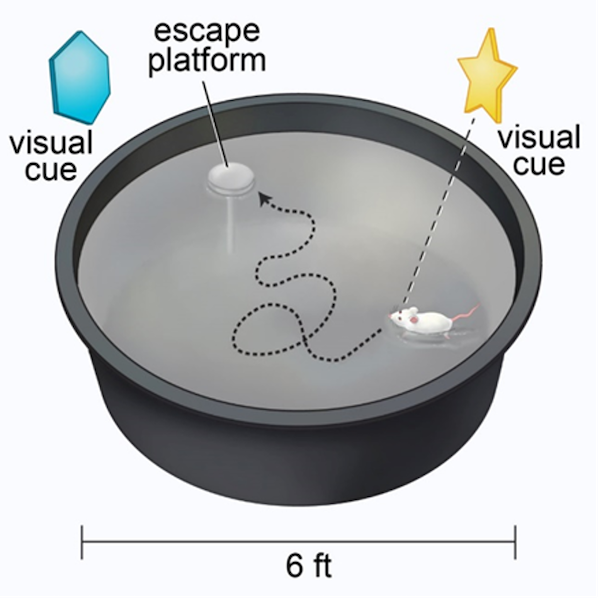 Figure | Morris water maze experiment. To test learning and memory, researchers placed mice in a pool of water with an escape platform. Visual cues were placed around the pool to help the mice navigate to the escape platform.
The Morris water maze test involves placing mice in a pool of water with an escape platform. Visual cues are placed around the pool to help the mice find the platform and escape drowning. Over two to three days of training, the mice memorize the platform's location, which remains in the same quadrant of the pool. On the day of testing, researchers remove the platform and record how often the mice cross, move, and spend time in the correct quadrant. The longer the mice spend in the target quadrant, the better their memory.
The researchers found that the senescence-accelerated mice crossed the target quadrant far fewer times than normal mice. The senescence-accelerated mice also showed reduced activity and spent less time in the target quadrant, suggesting impaired memory. Interestingly, administering NMN to the senescence-accelerated mice did not significantly increase the number of target quadrant crossings or the time spent in the correct quadrant. However, it did significantly increase the distance traveled, an effect that could be abolished by inhibiting Sirt1 with a compound called Ex527.
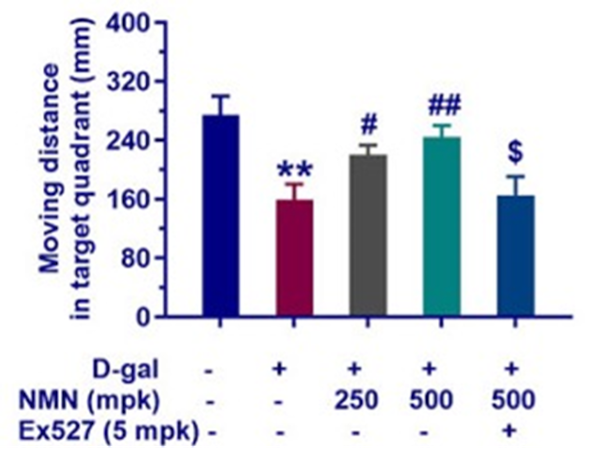 Figure | NMN-mediated sirtuin activation improves memory. D-galactose-accelerated aging mice (red) showed reduced movement in the target quadrant compared to normal mice (purple), indicated by **. Both 250 mg/kg (brown) and 500 mg/kg (turquoise) NMN reversed this effect, indicated by # and ##, respectively. However, this reversal was abolished when Sirt1 was inhibited by Ex527 (blue), indicated by $.
Given that NMN only increased the distance traveled within the target quadrant, and not the number of target quadrant crossings or the time spent in the correct quadrant, further research may be needed to confirm whether NMN can improve memory in the researchers' accelerated aging mouse model. That being said, previous studies have shown that NMN can significantly increase the number of target quadrant crossings in D-galactose-accelerated aging mice.
NMN activates Sirtuins to improve intestinal aging
One of the most intriguing findings from this study is how NMN-mediated Sirt1 activation improves intestinal health. Aging often leads to leaky gut, a condition increasingly linked to systemic inflammation and even neurodegenerative diseases. NMN treatment maintained the structural integrity of the intestinal lining and the number of goblet cells, which produce protective mucus. It also reduced inflammatory cell infiltration and promoted the restoration of crypt depth and villus height—indicators of intestinal barrier health.
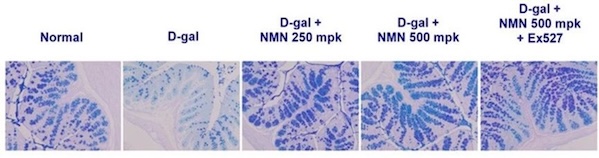 Figure | NMN-mediated sirtuin activation improves goblet cells. Goblet cells, which are crucial for intestinal health, are reduced in D-galactose mice, as indicated by blue dots. However, NMN at 250 or 500 mg/kg (mpk) restored goblet cell numbers, while Sirt1 inhibition by Ex527 suppressed goblet cell numbers.
The gut-brain axis is bidirectional. Intestinal barrier dysfunction allows bacterial endotoxins to enter the bloodstream, triggering systemic inflammation that subsequently affects the brain. NMN strengthens the gut barrier by activating Sirt1, potentially reducing neuroinflammation and potentially slowing neurodegeneration.
Of particular interest is how activation of Sirt1 protects both the brain and the gut, highlighting the role of the gut-brain axis. The findings also highlight the feasibility of increasing NAD+ levels and activating Sirtuins in multiple organs. Although the researchers did not study other organ systems, previous studies have shown that NMN can increase NAD+ levels in organs such as the heart, adipose tissue, and bone. Restoring NAD+ levels in these organs could protect against diseases of aging, including cardiovascular disease, metabolic syndrome, and osteoporosis.
The Sirtuin Signaling Cascade: How It Works
Research suggests that NMN's beneficial effects stem from its ability to activate a specific molecular pathway: Sirt1/AMPK/PGC-1α. When NAD+ levels are elevated due to NMN supplementation, Sirt1 becomes more active. This, in turn, activates an enzyme called AMPK (adenosine monophosphate-activated protein kinase), which in turn enhances the activity of PGC-1α (peroxisome proliferator-activated receptor gamma coactivator 1-α). Researchers have shown that NMN stimulates this molecular cascade, resulting in the following beneficial effects:
Enhanced mitochondrial health : more efficient cellular energy production
Reduced oxidative stress : Better management of harmful free radicals
Reduce inflammation : Lower levels of inflammatory molecules
Inhibit cell senescence : reduce senescent cells, thereby reducing the promotion of aging
Reduced apoptosis : Programmed cell death is reduced in healthy neurons
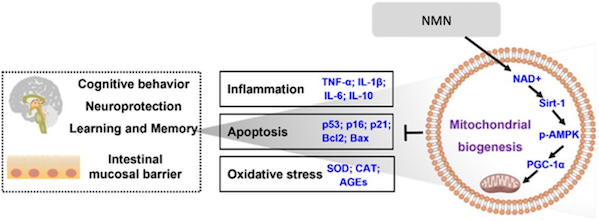 Figure | Summary of results. NMN improves brain and gut health by increasing cellular NAD+ levels. NAD+ activates Sirt-1, which in turn activates the longevity-associated enzyme AMPK. AMPK, in turn, activates PGC-1⍺, a master regulator of mitochondrial biogenesis. Mitochondrial biogenesis, the production of new mitochondria, can counteract mitochondrial dysfunction and reduce inflammation, apoptosis, and oxidative stress (blue markers).
Combining Sirtuin Activators with Other Longevity Interventions
Previous studies have shown that the effects of NMN and other NAD+ precursors are mediated by the activation of sirtuin enzymes. For example, in a mouse model of sepsis (systemic inflammation), NMN enhanced cognition and reduced inflammation unless Sirt1 was blocked. Although sirtuins use NAD+ as fuel, they can also be activated by other molecules. For example, NMN enhances the effects of a sirtuin activator called E1231 in combating metabolic syndrome.
Combining sirtuin activators (such as NAD+ precursors and E1231) with other longevity interventions can more broadly combat the multifaceted nature of cellular aging by targeting multiple biological drivers of aging, such as inflammation, mitochondrial dysfunction, and senescent cells. For example, lycopene, a potent antioxidant found in tomatoes, enhances the ability of NMN to improve memory in aging-accelerated D-galactose rats. Furthermore, combining NMN with prebiotics and dietary fiber can produce synergistic effects against Alzheimer's disease.
A clinical trial showed that a cocktail of compounds containing the NAD+ precursor NR (nicotinamide riboside) could reverse neurodegeneration and improve mitochondrial function in patients with Alzheimer's disease. This trial supports the use of sirtuin activators in combination with other longevity interventions to combat human aging, particularly brain aging. Companies such as Seragon Biopharmaceuticals have leveraged knowledge from combined longevity interventions to develop Restorin, which contains longevity interventions targeting multiple aspects of cellular aging.
By editor
Copyright©2026 Ddu. All rights reserved.
Read more on
- Telix teams up with Ekalia (IBA-Framatome JV) to scale up astatine-211 production in the U.S., advancing targeted alpha therapy October 19, 2026
- Haihe Biopharma’s oral paclitaxel (Bairuisu) approved for breast cancer, the world’s first oral paclitaxel October 19, 2026
- Beijing Fuyuan Pharmaceuticals aims to become the first generic version of a hypertension drug. October 19, 2026
- The first generic version of Ponatinib from Yuandong Bio has been approved for marketing October 19, 2026
- Clinical trial application for DR30206 for injection approved October 19, 2026
your submission has already been received.
OK
Subscribe
Please enter a valid Email address!
Submit
The most relevant industry news & insight will be sent to you every two weeks.