
First! FDA approves Gilead’s liver therapy
May 25, 2026
Source: drugdu
 162
162
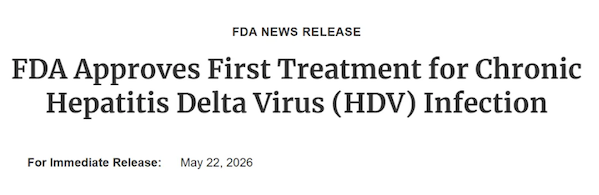
 On May 22, 2026, the FDA announced accelerated approval for Gilead 's Hepcludex (bulevirtide) injection for the treatment of chronic hepatitis D virus (HDV) infection in adults without cirrhosis or with compensated cirrhosis. Screenshot source: FDAThis approval not only marks the official birth of the first treatment for chronic HDV infection in the United States, but also fills a long-standing clinical gap in the field.HDV infection occurs only in individuals infected with hepatitis B virus (HBV), and can take the form of co-infection or superinfection. Compared to HBV infection alone, co-infection with HDV accelerates the progression of liver fibrosis and significantly increases the risk of cirrhosis, hepatocellular carcinoma, and liver disease-related death .
 Hepcludex was approved based on data from a Phase III clinical trial called MYR301. Results showed that at week 48, patients treated with Hepcludex 8.5 mg once daily had a comprehensive response rate (significantly reduced viral load and restored liver function) of 48%, compared to only 2% in the delayed treatment group.With prolonged treatment, the therapeutic effect showed a significant cumulative effect. At week 144, the undetectable rate of HDV RNA in the Hepcludex group increased to 50%. This means that about half of the patients could achieve "deep remission" with completely undetectable hepatitis D virus in their bodies after long-term treatment. Although Hepcludex received marketing approval from the European Medicines Agency (EMA) as early as 2020, its path to market in the United States has been exceptionally bumpy.After acquiring the German biotechnology company MYR GmbH (the original developer of Hepcludex), Gilead thought that with the endorsement of the European Union and solid efficacy data, approval in the United States would be a natural outcome.Back in 2022, the FDA issued a Complete Response Letter (CRL) to Hepcludex , citing deficiencies in the "manufacture and delivery" process , and directly rejected the application. At the time, this rejection not only caused Gilead's Chief Medical Officer, Merdad Parsey, to publicly express his "disappointment," but also caused the original developer, MYR GmbH, to lose the $360 million milestone payment it was expected to receive.After several years, the drug was finally approved, but it is rare for a pharmaceutical giant of Gilead to spend several years solving CMC (chemistry, manufacturing and control) issues.Fortunately, the FDA did not require new safety or efficacy clinical trials, and Gilead quickly addressed the manufacturing compliance issues and eventually passed the regulatory agency's rigorous review. As a world-first product, Hepcludex works by binding to the NTCP receptor on the surface of liver cells, blocking HDV and HBV from entering liver cells and thus inhibiting the spread of the virus within the liver. Previously, the FDA granted the drug Breakthrough Therapy Designation and Orphan Drug Designation.Of course, as a potent antiviral drug, Hepcludex also comes with clear risk warnings . Its drug label includes a "black box warning" indicating that discontinuing Hepcludex may lead to acute exacerbations of HDV and HBV infections. In addition, patients may experience side effects such as hypersensitivity reactions (including anaphylactic shock), injection site reactions, headaches, and fatigue during use. This requires clinicians to strictly monitor and manage patients when prescribing it.It is worth mentioning that in early 2026, the first prescription for "Huayounuo", a Chinese-developed hepatitis D treatment drug called ribevirtadalafil injection, was issued.From a clinical perspective, both drugs have their own strengths and weaknesses. Hepcludex has long-term follow-up data of up to 144 weeks, with a high degree of certainty in long-term efficacy; while the domestically produced "Huayounuo" has shown excellent performance in reversing liver fibrosis and reducing liver stiffness, and the dosing frequency is relatively low (once every two weeks, which can be adjusted to once every four weeks later).The successive launches of these two treatments provide more diverse and precise treatment options for hepatitis D patients with different characteristics worldwide.
https://mp.weixin.qq.com/s/CUIp2YxNrjHKuvqEaKTehA
By editor
Copyright©2026 Ddu. All rights reserved.
Read more on
- Rotigotine Transdermal Patch Receives Drug Registration Certificate, Expanding Its Parkinson’s Treatment Portfolio October 26, 2026
- Qilu Pharmaceutical’s Changqiping® inhaled spray approved for market launch, adding a new option for maintenance treatment of COPD October 26, 2026
- First generic version of a novel pulmonary arterial hypertension treatment drug approved for marketing. October 26, 2026
- Another global medical device giant has officially announced its spin-off! October 26, 2026
- Nobel Prize-winning company lays off 90% of its staff October 26, 2026
your submission has already been received.
OK
Subscribe
Please enter a valid Email address!
Submit
The most relevant industry news & insight will be sent to you every two weeks.