
Evidence-based breakthrough! Traditional Chinese medicine for anti-fibrosis selected again for the National Science and Technology Major Project
February 3, 2026
Source: drugdu
 509
509
In the field of liver disease, the long-term damage caused by the vast majority of chronic liver diseases leads to the occurrence and development of liver fibrosis. The degree and rate of progression of liver fibrosis directly affect the risk of cirrhosis and liver cancer. Therefore, effective intervention and reversal of the liver fibrosis process are of vital clinical significance.
Unlike other disease treatment areas, traditional Chinese medicine (TCM) has shown unique potential in this field. Recently, Ganxianle® , a modern TCM product under Baiyang Pharmaceuticals , which strengthens the body's resistance and removes blood stasis, participated in the National Science and Technology Major Project led by Beijing Ditan Hospital affiliated to Capital Medical University—"Research on the Comprehensive Evaluation System and Optimization Scheme of the Whole Chain of Integrated Traditional Chinese and Western Medicine Treatment to Reverse Hepatitis B Cirrhosis".
The selection criteria for the National Science and Technology Major Project are extremely high, aiming to solve "bottleneck" problems. Ganxianle (a traditional Chinese medicine) has not only long maintained a leading position in the anti-liver fibrosis market, but its selection this time is also a high recognition of its evidence-based value. This not only further consolidates the brand's benchmark image as an "evidence-based traditional Chinese medicine," but also provides a replicable successful model for the modernization of traditional Chinese medicine.
01
The Huge Market in Liver Disease: Evidence-Based Opportunities Amid Unmet Needs
Liver fibrosis is a major global health challenge with complex and diverse causes, primarily including viral hepatitis (such as hepatitis B and C), alcoholic liver disease, and non-alcoholic fatty liver disease/metabolic fatty liver disease. According to Frost & Sullivan analysis, the number of people with liver fibrosis worldwide reached 850 million in 2024, and this number continues to rise. China has a large patient population of approximately 140 million, and nearly half of these cases are related to hepatitis B virus infection.
Currently, the mainstream treatment for hepatitis B remains focused on antiviral therapy. Clinically, nucleoside (acid) analogues such as entecavir and tenofovir are widely used for etiological treatment. These drugs work by blocking viral DNA synthesis, effectively inhibiting viral replication, thereby reducing viral load and controlling the progression of liver inflammation.
However, while etiological treatment can halt disease progression, it is difficult to reverse existing liver fibrosis. If fibrosis is not effectively improved, it will continue to serve as the pathological basis of liver disease, accumulating and worsening, ultimately significantly increasing the risk of patients progressing to decompensated cirrhosis and liver cancer.
This reveals a clear clinical gap in the treatment of liver fibrosis. Therefore, combining standard antiviral therapy with drugs possessing proven antifibrotic effects is increasingly becoming an urgent unmet clinical need and points the way for breakthroughs in treatment strategies.
In the treatment of liver fibrosis, there is currently a lack of internationally recognized Western medicines. However, with its multi-target, multi-pathway, and multi-level mechanisms of action, traditional Chinese medicine (TCM) demonstrates unique potential for comprehensive regulation in anti-fibrosis, which naturally complements and synergistically benefits antiviral regimens that focus on treating the underlying cause. The "Guidelines for the Diagnosis and Treatment of Liver Fibrosis Using Integrated Traditional Chinese and Western Medicine" (2019 edition) points out that TCM has clear advantages in the field of anti-fibrosis , and several TCM preparations with registered indications for liver fibrosis have already been marketed, including Fuzheng Huayu Capsules (Tablets).
In fact, the concept of "dual antiviral therapy"—combining antiviral and antifibrotic treatments for hepatitis B—was first proposed and implemented by Fuzheng Huayu in 2009. As a pioneer of this concept and a leading brand in the field of anti-liver fibrosis, Fuzheng Huayu has maintained a stable market position. According to Yaozhi data, among anti-liver fibrosis products, Ganxianle (Fuzheng Huayu) has consistently held the number one market share, accounting for nearly 38% in the first three quarters of 2025.
However, it is noteworthy that less than 7% of hepatitis B patients receiving antiviral treatment in clinical practice also use traditional Chinese medicine (TCM) for combined antifibrotic therapy. This indicates that the vast majority of patients have not yet initiated a "dual antiviral therapy" approach combining antiviral and antifibrotic treatments. There is still significant room for TCM to penetrate the clinical market in this area.
Meanwhile, chronic hepatitis B, as the leading cause of liver fibrosis, directly determines the growth potential of the anti-fibrotic market due to the effectiveness of its prevention and control. Currently, there is still a significant gap between the current state of hepatitis B prevention and control in my country and the ideal goal—data from Polaris Observatory Collaborators shows that the current diagnosis rate and treatment rate of HBV infection in my country are 24% and 15%, respectively, while the World Health Organization (WHO) has proposed a 2030 target for hepatitis B prevention and control, explicitly requiring a diagnosis rate of 90% and a treatment rate of 80%.
With the increasing diagnosis and treatment rate of hepatitis B patients, the anti-fiber market will usher in a definite growth opportunity. This trend will also provide a continuous and certain market development space for core brands with clear clinical positioning, such as Ganxianle (Fuzheng Huayu).
02
Evidence-based breakthrough:
Multiple studies provide solid data, upgrading the standards for traditional Chinese medicine in anti-fibrosis treatment.
The key to the success of traditional Chinese medicine in the anti-fibrotic treatment field lies in building a solid evidence-based medical system.
Ganxianle (Fuzheng Huayu) continues to lead the anti-liver fibrosis field, far ahead of its competitors. Its fundamental driving force lies in its clinical evidence system, which surpasses that of its peers. Through undertaking major national projects and completing international clinical trials, it has systematically built the core foundation for efficacy and safety, not only proving the product's value but also powerfully promoting evidence-based innovation in traditional Chinese medicine.
As the only traditional Chinese medicine for liver disease to complete Phase II clinical trials in the United States, Ganxianle (Fuzheng Huayu) was also selected for my country's "12th Five-Year Plan" major project, which verified the advantages of "dual anti-inflammatory therapy". The study included patients with compensated chronic hepatitis B cirrhosis in 20 centers to evaluate the safety and efficacy of Fuzheng Huayu tablets combined with entecavir for the treatment of hepatitis B cirrhosis.
The study validated the efficacy through two liver biopsies before and after treatment. Data showed that the cirrhosis reversal rate in treatment-naïve hepatitis B cirrhosis patients was 64.6%, which was 14.6% higher than that of entecavir (ETV) monotherapy. In previously treated HBV-DNA negative hepatitis B cirrhosis patients, the addition of tonifying and blood-activating therapy resulted in a cirrhosis reversal rate of 56%, which was 15% higher than the control group treated with entecavir monotherapy. The study found that both treatment-naïve hepatitis B cirrhosis patients and previously treated patients with HBV-DNA seroconversion, treated with a combination of tonifying and blood-activating therapy and entecavir for 48 weeks, effectively reversed cirrhosis with good safety.
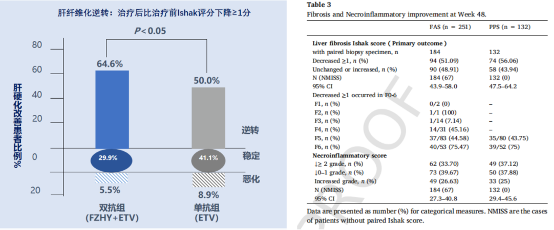 Image source: Report of the 12th Five-Year Plan Project of Major National Science and Technology Project: "Clinical Study on the Treatment of Hepatitis B Cirrhosis with Traditional Chinese Medicine Combined with Entecavir" (No: 2014ZX10005001)
In addition, two large-scale retrospective cohort studies, focusing on reducing the risk of liver cancer, further confirmed the long-term value of Ganxianle (Fuzheng Huayu) in real clinical scenarios—it can reverse liver fibrosis and block the progression chain of "hepatitis-cirrhosis-liver cancer".
A single-center retrospective cohort study conducted by Beijing Ditan Hospital included 842 patients with hepatitis B-related cirrhosis. Using a 1:1 propensity score matching analysis, the patients were divided into a supportive and antiviral therapy group (n=259) and a control group that received antiviral therapy alone (n=259).
Five-year follow-up data showed that the incidence of liver cancer in patients treated with Ganxianle (a traditional Chinese medicine) combined with antiviral therapy was only 10.0%, which was 56.9% lower than the risk of liver cancer in the control group treated with antiviral therapy alone. Moreover, the degree of benefit to patients was positively correlated with the duration of medication.
Another retrospective cohort study covering 20 centers nationwide and including 910 patients with compensated cirrhosis showed that the incidence of liver cancer in the dual anti-inflammatory combination therapy group was 9.8%, compared to 21.8% in the control group. This study further validates that Fuzheng Huayu tablets, when combined with entecavir therapy, can reduce the risk of liver cancer in patients with hepatitis B-related cirrhosis, bringing long-term survival benefits to patients.
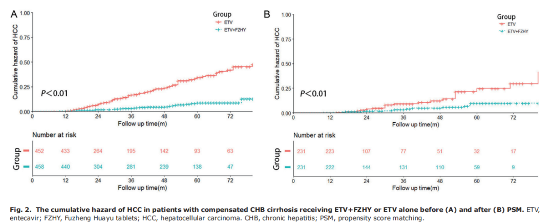 Image source: "Beneficial Effects of Traditional Chinese Medicine Fuzheng Huayu on the Occurrence of Hepatocellular Carcinoma in Patients with Compensated Chronic Hepatitis B Cirrhosis Receiving Entecavir: A Multicenter Retrospective Cohort Study"
Tracing the mechanism of action of Ganxianle (Fuzheng Huayu), studies have shown that Fuzheng Huayu can act on 10 aspects of liver fibrosis, exerting its anti-liver fibrosis effect through three major mechanisms: reshaping the liver matrix structure, inhibiting stellate cell activation, and reducing hepatocyte damage.
Another point of particular concern is that the implementation of Article 75 of the National Medical Products Administration's "Special Provisions on the Registration Management of Traditional Chinese Medicines" (effective July 1, 2026) is now in its final window. A large number of traditional Chinese medicine products with "not yet clear" entries for "contraindications," "adverse reactions," and "precautions" in their instructions face the risk of being withdrawn from the market. However, the instructions for Ganxianle Fuzheng Huayu Tablets/Capsules contain complete information on these three core safety aspects, giving it a compliance advantage and laying the foundation for its market competitiveness.
03
Conclusion
The value of traditional Chinese medicine in treating liver fibrosis is shifting from experience-based inheritance to evidence-based guidance. Multiple clinical studies of Ganxianle (a traditional Chinese medicine formula) have confirmed that for hepatitis B patients, the " dual antiviral + antifibrotic" treatment can not only reverse liver fibrosis but also significantly reduce the risk of cirrhosis and liver cancer , providing a safe and effective liver cancer prevention solution for high-risk groups of chronic liver disease.
Leveraging its evidence-based advantages and translational experience in the field of liver fibrosis, Baiyang Pharmaceuticals has made "anti-organ fibrosis" a key area of innovation. In addition to liver fibrosis, Baiyang Pharmaceuticals has further expanded its pipeline in pulmonary fibrosis and renal fibrosis through strategic investment in Jikun Pharmaceuticals, with pulmonary fibrosis already in clinical research. In the future, with the accumulation of more high-quality evidence and the continued advancement of its pipeline, Baiyang Pharmaceuticals is expected to maintain its leading position in the broad field of fibrotic diseases.
https://news.yaozh.com/archive/47071.html
By editor
Copyright©2026 Ddu. All rights reserved.
Read more on
- CPHI Milan 2026 Recap | What Did Drugdu.com Bring Back from Milan? October 9, 2026
- Novo Nordisk and Nanexa Ink Up to €1.165B Long-Acting Delivery Deal for Obesity and Diabetes September 29, 2026
- siRNA Biotech ADARx Raises $446M in 2026’s Third-Largest Biotech IPO September 29, 2026
- Merck and Eisai’s Welireg Plus Lenvima Approved by FDA for Previously Treated Advanced Kidney Cancer September 29, 2026
- Mirum and Incyte’s Atebrioz Wins FDA Approval for Rare Bone Disorder FOP September 29, 2026
your submission has already been received.
OK
Subscribe
Please enter a valid Email address!
Submit
The most relevant industry news & insight will be sent to you every two weeks.