
Boston Scientific is investing $5 billion to begin “slimming down”.
August 3, 2026
Source: drugdu
 111
111
Boston Scientific recently announced that it will launch a global restructuring plan this year.
01
$800 million:
Saving money with one hand and spending money with the other.
According to documents filed by Boston Scientific with the SEC, this global restructuring plan is expected to officially launch in 2026, with an execution period spanning nearly four years and a target of being largely completed by the end of 2029. The restructuring covers four main areas: global supply chain optimization, capacity reallocation among production bases, systemic transformation of specific functions, and organizational restructuring to ensure suitability.
Financially, Boston Scientific anticipates that the restructuring will generate $700 million to $800 million in pre-tax costs, of which approximately $600 million to $700 million will be actual cash costs to be incurred in the future. Breaking down the costs, severance pay is estimated at $275 million to $300 million, production line relocation-related expenses are approximately $300 million to $350 million, and the remaining $125 million to $150 million covers consulting fees, contract termination fees, and other related expenses.
Furthermore, Boston Scientific expects to reduce pre-tax operating costs by approximately $500 million annually upon full completion of the restructuring, with most of the savings reinvested in growth-oriented businesses.
Regarding personnel changes, Boston Scientific stated in its SEC filing that while new positions have been created in growth areas and resources have been continuously allocated to match changes in the business portfolio and global market demands, the restructuring inevitably involves some layoffs. This structural adjustment also reflects that while Boston Scientific is reducing non-core costs, it is still building up its talent pool for high-growth areas, carrying out both "addition" and "subtraction" in parallel.
Overall, this global restructuring, spanning nearly four years and covering three major aspects—supply chain, production layout, and organizational structure—is essentially using one-time short-term cost pain to achieve a systemic improvement in long-term operational efficiency. It is worth noting that in recent years, Boston Scientific has consistently pursued an "acquisition strategy," with multiple major acquisitions coming to fruition. The implementation of the restructuring plan may be a signal that Boston Scientific is preparing for larger-scale business integration and optimizing related costs.
In 2026, Boston Scientific completed several major acquisitions. Among them, in January of this year, Boston Scientific announced the acquisition of Penumbra for approximately $14.5 billion, strengthening its position in the cardiovascular sector. This transaction is the second largest acquisition in Boston Scientific's M&A history and is expected to be completed in 2026.
It is worth noting that this strategy of "saving money with one hand and spending money with the other" has become increasingly common among international giants in recent years. The essence of this strategy is to quickly acquire new technologies and enter new markets through mergers and acquisitions, while improving collaborative efficiency through internal adjustments and optimization of organizational structure, and focusing on the next new growth point.
02
Revenue of US$5.442 billion,
growth of the two main engines slowed down
However, excluding the factor of multiple high-priced acquisitions, considering the current situation, Boston Scientific's global restructuring is also a proactive adjustment under pressure.
On July 29th, Boston Scientific released its Q2 2026 financial report, showing revenue of $5.442 billion, a year-on-year increase of 7.5%; net profit of $907 million, a year-on-year increase of 13.8%. Among the various business segments, cardiovascular revenue was $3.624 billion, a year-on-year increase of 8.3%, and medical surgery revenue was $1.818 billion, a year-on-year increase of 5.9%.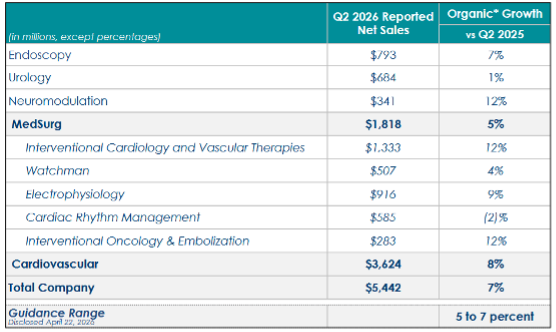 Image source: Boston Scientific Q2 financial report
Although Q2 financial data still shows double-digit growth, a clear slowdown in overall growth is evident, primarily due to the deceleration of core businesses.
In particular, the first-mover advantage in electrophysiology is gradually diminishing. Boston Scientific, a pioneer in PFA (polyphenol oxidase) technology, possesses a first-mover advantage in the promising and rapidly growing PFA market, thanks to its core product, Farapulse, the world's first FDA-approved PFA product. However, this first-mover advantage is being challenged. In Q2, Boston Scientific's electrophysiology revenue was $916 million, a year-on-year increase of 9%.
Meanwhile, the PFA market is booming, with intensifying competition. Among the leading players, Medtronic and Johnson & Johnson are accelerating their catch-up efforts based on their differentiated technological advantages. Recent developments include Johnson & Johnson's FDA approval of its dual-energy PFA product, THERMOCOOL SMARTTOUCH SF platform; Medtronic's multi-product portfolio is also progressing steadily, and according to its recent financial report, its PFA products Sphere-9 and PulseSelect have achieved growth exceeding 300% in both the US and overseas markets.
Meanwhile, the growth momentum of another major engine—the Watchman left atrial appendage occluder—is also slowing significantly. The Watchman left atrial appendage occluder is Boston Scientific's flagship product in structural heart disease, primarily used to reduce the stroke risk in patients with atrial fibrillation. However, in Q2, sales of this product reached $507 million, a year-on-year increase of only 4%, indicating that its growth rate has shifted from high growth to plateauing.
Looking at other products, the interventional cardiology and vascular therapy, neuromodulation, and interventional oncology and embolization business segments achieved growth of 12%, but in terms of scale, only interventional cardiology and vascular therapy have a large enough market share to potentially take over, though this may be difficult to achieve in the short term.
The slowdown in the growth of these two major engines has led Boston Scientific to lower its full-year outlook, reducing its full-year organic revenue growth forecast to 5%-6%.
03
Conclusion
Returning to the practicalities, the reasons behind Boston Scientific's global restructuring are not difficult to understand. Slowing growth in electrophysiology and weak demand for Watchman have simultaneously slowed the growth of its two core engines, making cost restructuring an inevitable choice. However, the effectiveness of the restructuring remains to be seen. Will the $800 million in costs over four years result in a stopgap measure or a path to profitability? Under the dual pressures of intensified competition in PFA and pressure on Watchman sales, will cost reductions be sufficient to offset the decline in revenue? Can a new growth engine emerge as expected within the restructuring window?
Of course, these questions are difficult to answer in the short term. However, Boston Scientific's proactive adjustments and search for new growth points amidst a sluggish growth trajectory are commendable. Given the backdrop of slowing growth, intensified competition, and continued pressure from healthcare cost control in the medical device industry, Boston Scientific's restructuring plan is not uncommon, nor will it be an isolated case. In a competitive environment of existing market share, whoever can adjust their cost structure more quickly and integrate resources more efficiently will occupy a more advantageous position in the next cycle.
https://news.yaozh.com/archive/48810.html
By editor
Copyright©2026 Ddu. All rights reserved.
Read more on
- Novo Nordisk and Nanexa Ink Up to €1.165B Long-Acting Delivery Deal for Obesity and Diabetes September 29, 2026
- siRNA Biotech ADARx Raises $446M in 2026’s Third-Largest Biotech IPO September 29, 2026
- Merck and Eisai’s Welireg Plus Lenvima Approved by FDA for Previously Treated Advanced Kidney Cancer September 29, 2026
- Mirum and Incyte’s Atebrioz Wins FDA Approval for Rare Bone Disorder FOP September 29, 2026
- J&J in Talks to Sell DePuy Synthes to Apollo September 29, 2026
your submission has already been received.
OK
Subscribe
Please enter a valid Email address!
Submit
The most relevant industry news & insight will be sent to you every two weeks.