
A single-quarter revenue of 4.4 billion! The “King of Nuclear Drugs” ignites precision treatment for prostate cancer
May 25, 2026
Source: drugdu
 183
183
With quarterly sales of $642 million (approximately RMB 4.4 billion), a 70% year-on-year increase, Pluvicto, the "king of nuclear drugs," is pushing precision treatment for prostate cancer into a new era of explosive growth with an almost overwhelming momentum.
Novartis' Q1 2026 report shows that the sales curve of this prostate cancer radioligand therapy continues to be steep: $280 million in its first year of launch in 2022, $980 million in 2023, $1.392 billion in 2024, and $1.994 billion for the whole of 2025, maintaining a growth rate of over 40% for three consecutive years , officially becoming the world's first radiopharmaceutical product to break the $1 billion mark.
Multinational giants, the "kings of nuclear medicine," are making great strides in the prostate cancer field, while domestic innovative forces are also accelerating their progress . Hengrui Medicine's self-developed PSMA-targeted nuclear medicine HRS-4357 has started Phase III clinical trials; Hansoh Pharmaceutical's self-developed B7-H3-targeted ADC drug HS-20093 was approved by the National Medical Products Administration in April 2026 for inclusion in the Breakthrough Therapy Program.
The emergence of a prostate cancer drug is triggering an industry-wide resonance, from multinational pharmaceutical companies to local innovations.
This series of figures and events points to the same core question: Where exactly has targeted therapy for prostate cancer progressed? To answer this question, let's turn back the clock to 1941.
01
Evolution of Targeted Therapy for Prostate Cancer
1. A Nobel Prize-level starting point – the establishment of ligand binding domain strategy
The origin of prostate cancer drug development can be traced back to the groundbreaking discovery by Charles Huggins of the University of Chicago in 1941. He observed that in patients with advanced prostate cancer who underwent orchiectomy or estrogen injection, elevated serum acid phosphatase levels rapidly decreased, and clinical symptoms caused by bone metastases quickly improved. This research established the underlying principle of all prostate cancer treatments for decades to come— tumor growth is highly dependent on androgen signaling, and cutting off this signaling can inhibit tumor growth . Huggins was awarded the Nobel Prize in Physiology or Medicine in 1966 for this work.
The discovery of Huggins not only opened the door to endocrine therapy for prostate cancer but also fundamentally defined a core direction in drug development: how to more effectively block the binding of androgens to their receptors . The androgen receptor (AR) has a clearly defined drug-binding site— the ligand-binding domain (LBD) . For more than half a century since then, the pharmaceutical industry has focused almost entirely on designing more sophisticated drugs to occupy this site. The iterations from first-generation to second-generation AR inhibitors have essentially followed this ligand-binding domain strategy.
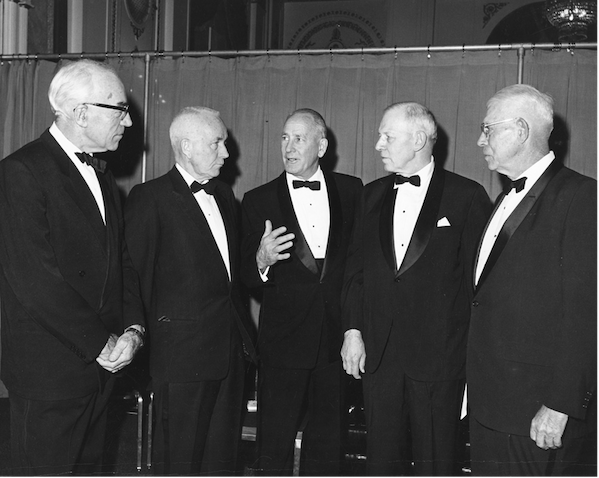 Huggins poses for a photo with other Nobel laureates.
Image source: https://photoarchive.lib.uchicago.edu/db.xqy?one=apf1-02882.xml
Bicalutamide – A first-generation oral anti-androgen drug
In 1995, AstraZeneca launched bicalutamide, which works by competitively occupying LBD. However, its binding is reversible and its affinity is limited, gradually losing its effectiveness as AR amplifies, and it was gradually replaced by second-generation drugs.
Enzalutamide – A bombshell with annual sales of $8 billion
In 2012, enzalutamide (Medivation/Asteralis) was approved in the United States, with a 5-8 fold increase in receptor affinity and an expanded mechanism of action that included triple blockade. In 2016, Pfizer acquired 50% of Medivation's US rights for $14 billion, and its global sales are projected to reach approximately $8 billion by 2024, making it the market leader.
Apalutamide and dallotamide – The ligand strategy market is reaching its peak.
Apalutamide (Johnson & Johnson) was approved by the FDA in 2018, and its global sales are expected to reach approximately $3 billion by 2024. Darlotamide (Bayer/Orion) was approved in 2019, and its low blood-brain barrier permeability allows it to differentiate itself in elderly patients. It is expected to surpass €1 billion in annual sales by September 2024.
2. Structural vulnerabilities and three breakout paths
Beneath the sales figures, structural vulnerabilities are accumulating. Cancer cells have evolved AR-V7 splice variants, which retain the core functional domains that promote cancer cell proliferation but completely discard LBD. All second-generation AR inhibitors lack binding sites in their chemical structures, signaling the end of the ligand-binding domain strategy in the mCRPC stage. The industry is breaking through from almost three directions simultaneously:
Path 1: Find the second weakness. Utilize DNA repair gene defects such as BRCA1/2 to precisely kill the target through synthetic lethal mechanisms (PARP inhibitors).
Pathway Two: Directly Overcoming AR Resistance. Instead of inhibiting AR function, this involves directly degrading it. For example, PROTAC technology physically removes the entire AR protein, including AR-V7.
Path 3: Find new coordinates independent of the AR signal axis (PSMA, KLK2, B7-H3, etc.) to carry out targeted killing by dual-antibody activated immunity, ADC-coupled chemical warheads, or RDC-coupled nuclide warheads.
3. Implementation attempts and results of the three paths
Pathway 1: PARP inhibition
The theoretical basis is synthetic lethality. Olaparib (AstraZeneca/Merck) is the first PARP inhibitor approved for prostate cancer, with global sales of $1.45 billion in 2025. It was approved in China in July 2025 for BRCA-mutated mCRPC. Niraparib and tapolaparib have subsequently entered the market, and Hengrui's fluzoparib application has also been accepted, suggesting a potential "four-way battle" in the domestic market. However, the beneficiary population is limited to HRR mutation-positive individuals (20%-30%), making gene testing penetration a key bottleneck.
Pathway Two: Overcoming AR Drug Resistance
Arvinas, a global leader in AR clinical trials, acquired exclusive global rights to its molecule ARV-766 in 2024 for a total transaction value of $1.16 billion, renaming it JSB462. Phase III clinical trials are underway overseas, while Phase II trials have been approved in China. Early clinical data shows a significant proportion of AR LBD-mutant patients experiencing a PSA reduction of over 50%. In China, Hengrui's HRS-5041 is the first domestically produced AR protocol. Its combination with HRS-4357 received clinical approval in January 2026. As of January 2026, the cumulative R&D investment in HRS-5041-related projects is approximately RMB 92.66 million.
Path 3: Exploring New Targets
In the bispecific antibody (BSA) field, Johnson & Johnson's Pastritamig (KLK2/CD3) Phase I clinical trial has a median progression-free survival of nearly 8 months. In the ADC field, Hansoh's HS-20093 (B7-H3 ADC) received Breakthrough Therapy Designation in April 2026. In the RDC field, Novartis has coupled a PSMA-targeting ligand with lutetium-177, and the three pivotal Phase III studies VISION, PSMAfore, and PSMAddition have validated the benefit of transitioning from late-line to early-line therapy. Pluvicto's revenue is projected to reach $1.994 billion in 2025, and Novartis has invested 600 million yuan to build a production base in Haiyan, which will be operational by the end of 2026. The competitive advantage lies in the supply of carrier-free Lu-177 and the distribution network of radiopharmacy pharmacies. Domestically, Hengrui has invested approximately 380 million yuan in the R&D of HRS-4357, while Grand Pharma's TLX591 integrated diagnosis and treatment strategy is progressing simultaneously.
02
Industry landscape
The previous section, from a biological mechanism perspective, divided the breakthrough of targeted therapy for prostate cancer after the failure of ligand binding domain strategies into three paths. The competitive landscape at the industry level can also be examined along these three paths—on each path, the positions, key data, and prospects of multinational pharmaceutical companies and domestic players differ.
Direction 1: Finding the second weakness – PARP inhibitors
PARP inhibitors represent the most commercially mature of the three pathways. The global market size was approximately $3.19 billion in 2023 and is projected to reach $8.62 billion by 2032, representing a CAGR of 11.7%. The core logic of this sector is synthetic lethality, using genetic testing to identify individuals with HRR mutations. Major players include AstraZeneca/Merck, Pfizer, Johnson & Johnson, and Hengrui. In June 2023, Pfizer's taprazole was approved by the FDA in combination with enzalutamide for first-line treatment of HRR-mutant mCRPC, with the TALAPRO-2 study showing a 55% reduction in the risk of radiographic progression or death. Johnson & Johnson's niraparib in combination with abiraterone has been approved in the EU, with the MAGNITUDE study showing a 45% improvement in rPFS. Hengrui's application for a new indication for fluzoparib has been accepted, establishing a four-way competition in the domestic market. The key bottleneck in this direction lies in the penetration rate of genetic testing—HRR mutations only account for 20% to 30% of mCRPC cases, and the actual testing rate among domestic patients remains low. Promoting widespread testing is crucial for unlocking market growth.
Direction Two: Overcoming AR Drug Resistance Directly – PROTAC
PROTACs represent the most technologically challenging of the three pathways, primarily due to their drug-like properties. The core logic is the physical degradation of the entire AR protein to circumvent LBD resistance. Arvinas' JSB462, a global leader, achieved a PSA reduction of over 50% in 43% of AR LBD-mutant patients after treatment, with no observed dose-limiting toxicities. Novartis acquired the global rights to this molecule for a total of $1.16 billion, aiming to create a dual-asset matrix with Pluvicto and JSB462. Domestically, Hengrui's HRS-5041 is the first domestically developed AR PROTAC, and its combination therapy with the nuclear drug HRS-4357 is expected to receive clinical approval in January 2026. Its prospects depend on whether PSA signaling can translate into survival benefits and whether the oral drug-like properties can be optimized; Phase III data will be a key validation node.
Direction 3: Exploring new targets for targeted killing – dual resistances, ADCs, and RDCs
This is the track with the most participants and the most diverse modalities among the three paths. Each of the three types of drugs has groundbreaking data to support its claims.
Regarding dual antiplatelet therapy, the 2026 ASCO GU meeting announced that Johnson & Johnson's Pastritamig (KLK2/CD3) combined with docetaxel achieved an overall PSA50 response rate of 64.7% in previously treated mCRPC patients, with a response rate as high as 88.2% in patients with bone metastases, and no CRS was observed. Johnson & Johnson has initiated two Phase III studies, and Amgen's AMG 160 (PSMA/CD3) is also under development.
In the ADC field, at the ASCO GU meeting that same year, it was announced that Hansoh HS-20093 (B7-H3 ADC) demonstrated an objective response rate of 33.3%, a disease control rate of 87.9%, and a 9-month relapse-free survival (rPFS) rate of 55.7% in previously treated mCRPC. GSK obtained exclusive global licensing rights for this drug outside of Greater China in December 2023. Pfizer's $43 billion acquisition of Seagen established one of the world's largest ADC pipelines.
In the RDC (Radioactive Drug Distribution) sector, Pluvicto leads the radiopharmaceutical market with a projected annual revenue of $1.994 billion in 2025. It recently received Breakthrough Therapy Designation from mHSPC, potentially expanding the number of eligible patients by another 75% (P). Domestically, Hengrui's HRS-4357 and Grand Pharmaceutical's integrated diagnostic and therapeutic pipelines are progressing simultaneously, while Dongcheng Pharmaceutical/Lannacheng's 177Lu-LNC1004 has entered clinical trials. The competitive barriers in this pathway are diverse: bispecific antibodies rely on the speed of new target validation, ADCs on linker technology and toxicity control, and RDCs on a stable supply of radionuclides and the coverage radius of the distribution network.
03
Conclusion
Returning to the original question, where is targeted therapy for prostate cancer at?
In terms of treatment logic, the single-pathway attack and defense is being replaced by a comprehensive three-pronged approach. In terms of the market, enzalutamide solidified its position as a cornerstone of endocrine therapy with approximately $8 billion in revenue, Pluvicto opened up the nuclear drug market with $642 million in a single quarter, olaparib embodies the logic of precision testing, and Pfizer's $43 billion acquisition of Seagen represents a high-stakes bet on ADCs. The global market is projected to reach $9.17 billion in 2025 and $20.67 billion in 2035.
Based on the evolution and data, three directions can be deduced. First, the paradigm shift from inhibition to degradation has entered the validation phase; second, the decision-making logic from experience to subtyping is gradually being implemented, with detection penetration rate being a key variable; third, the exploration from monotherapy to combination therapy has entered clinical trials, and the safety risk spectrum needs to be assessed.
Looking back at the evolution, for more than half a century, the core idea of prostate cancer drug development has been " to more subtly interfere with androgen signaling ." AR-V7 exposed the fundamental boundaries of the entire LBD strategy. The three subsequent pathways—synthetic lethality, protein degradation, and targeted killing of new targets—essentially answer the same question: once cancer cells have learned to bypass their most proficient pathways, are there second or third completely different sets of tactical languages?
The maturity of an industry lies not in the number of blockbuster drugs it possesses, but in whether it holds a trump card when facing the most stubborn drug resistance mechanisms. In this sense, the most exciting aspect of targeted therapy for prostate cancer today is not Pluvicto's single-quarter revenue of $642 million, but rather the strategic depth of multiple approaches, multiple tiers, and multiple backups that this figure represents.
https://news.yaozh.com/archive/48136.html
By editor
Copyright©2026 Ddu. All rights reserved.
Read more on
- Five innovative drugs approved for marketing September 11, 2026
- Subsidiary’s novel coronavirus mRNA vaccine receives drug registration certificate September 11, 2026
- Lincomycin Hydrochloride Injection passes generic drug consistency evaluation September 11, 2026
- CSPC Pharmaceutical Group’s innovative chemical drug SYH2083 eye drops approved for clinical trials in China September 11, 2026
- Novel influenza virus mRNA vaccine approved for clinical trials September 11, 2026
your submission has already been received.
OK
Subscribe
Please enter a valid Email address!
Submit
The most relevant industry news & insight will be sent to you every two weeks.


