
A New Treatment Option for Pulmonary Fibrosis! Boehringer Ingelheim’s New Drug Approved
May 19, 2026
Source: drugdu
 201
201

On May 18, 2026, Boehringer Ingelheim announced that the Japanese Ministry of Health, Labour and Welfare had approved JASCAYD (nerandomilast) for the treatment of idiopathic pulmonary fibrosis (IPF) and progressive pulmonary fibrosis (PPF) in adults .
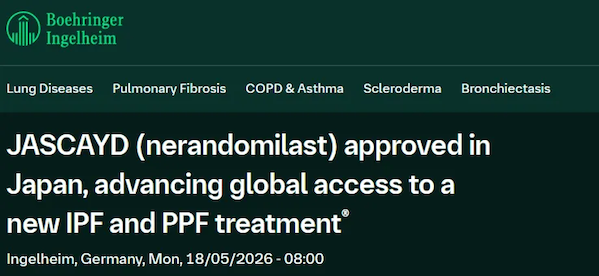 According to the press release, JASCAYD® is the first PDE4B inhibitor approved for the relevant indication, possessing both anti-fibrotic and immunomodulatory effects, providing a new treatment option for patients with IPF and PPF.Idiopathic pulmonary fibrosis and progressive pulmonary fibrosis are rare and difficult-to-cure diseases with limited treatment options. The approval of JASCAYD is a major achievement with the potential to revolutionize the treatment paradigm for these diseases.JASCAYD® possesses a novel mechanism of action, exerting anti-fibrotic and anti-inflammatory effects in the lungs, demonstrating a slowing effect on the decline of lung function in both FIBRONEER-IPF™ and FIBRONEER-ILD™. Furthermore, a meta-analysis of these trials showed a nominally significant reduction in the risk of death.The approval of JASCAYD® is supported by results from the Phase III FIBRONEER-IPF™ and FIBRONEER-I LD™ trials, the largest Phase III programs to date for IPF and PPF. In both trials, nerandomilast met its primary endpoint of significantly improving forced vital capacity (FVC) from baseline at week 52 compared to placebo.
•
In the FIBRONEER™-IPF study: the 9 mg group showed a difference of 44.9 mL in FVC improvement compared to the placebo group; the 18 mg group showed a difference of 68.8 mL in improvement; both groups showed a statistically significant advantage over placebo.
•
•
In the FIBRONEER™-ILD study: the 9 mg group showed an improvement of 81.1 mL in FVC compared to the placebo group; the 18 mg group showed an improvement of 67.2 mL; both groups showed statistically significant differences, indicating that nerandomilast was superior to placebo.
•
However, nerandomilast failed , namely the time to first occurrence of the composite event: acute IPF/ILD exacerbation, first hospitalization for respiratory reasons, or death. But a pooled analysis of the two trials found that patients in the 18 mg group who did not receive existing antifibrotic therapy had a significantly lower risk of death by 59% compared to placebo.
In terms of safety, the most common adverse event with nerandomilast is diarrhea, most of which are mild to moderate. The overall discontinuation rate is within a manageable range, demonstrating good tolerability. Currently, in addition to the countries where it has been approved, its marketing applications for IPF and PPF indications are under review in the EU, UK, and other regions, with further expansion of approval expected in 2026. Meanwhile, researchers are also exploring its therapeutic potential in rheumatic diseases such as systemic sclerosis (SSc) and myositis (IIM).
https://mp.weixin.qq.com/s/YnPHGAx77NXF85kvN-17HA
Copyright©2026 Ddu. All rights reserved.
Read more on
- What Are Buyers Looking For, and What Are Suppliers Focused On? September 23, 2026
- Novartis acquires Sironax’s blood-brain barrier delivery platform for $125 million September 17, 2026
- IASO Bio’s in vivo CAR-T IASO208 receives FDA clinical trial clearance September 17, 2026
- NMPA accepts marketing registration application for Velsipity domestic manufacturing transfer September 17, 2026
- Ziprasidone mesylate from SSY Group has been approved for registration as an active pharmaceutical ingredient. September 17, 2026
your submission has already been received.
OK
Subscribe
Please enter a valid Email address!
Submit
The most relevant industry news & insight will be sent to you every two weeks.