
GE Healthcare’s Photon-Counting CT System Approved by FDA
March 30, 2026
Source: drugdu
 350
350
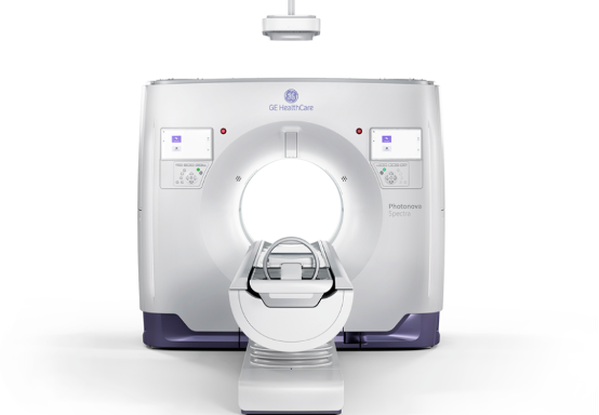
Recently, GE Healthcare announced that its photon-counting CT system, Photonova Spectra, has received 510(k) marketing clearance from the U.S. Food and Drug Administration.
It is understood that this product features wide-area coverage and ultra-high-resolution spatial and spectral imaging capabilities, enabling rapid acquisition and precise display of subtle tissue differences, small lesions, and vascular structures. Moreover, equipped with its self-developed deep silicon detector technology, it builds a flexible photon-counting CT platform that can meet diverse clinical needs through various configurations.
Its deep silicon technology offers 8-energy-level spectral resolution, supporting advanced material separation and characterization capabilities, allowing Photonova Spectra to accurately distinguish between different substances such as iodine, calcium, and fat. The wide-area detector coverage combined with a fast rotation speed of 0.23 seconds ensures high-speed acquisition and motion-artifact-free imaging.
Furthermore, Photonova Spectra can automatically and simultaneously acquire 8-energy-level spectral data and ultra-high-resolution spatial data without requiring special settings or scanning protocols, ensuring spectral information is obtained with every examination.
Traditional CT requires converting X-rays into light signals before measurement, whereas photon-counting CT can directly count individual X-ray photons. By measuring photon energy, it achieves higher potential spectral and spatial resolution, optimizing tissue characterization capabilities. The new detector material, deep silicon technology, further enhances spectral imaging performance, aiding in precise lesion identification and treatment monitoring.
According to GE Healthcare, this system can improve diagnosis and treatment levels in neurology, oncology, musculoskeletal, thoracic, and cardiac fields: in neurology, it can clearly display minute brain structures; in oncology, it enables precise lesion characterization; simultaneously, it can clearly show subtle fractures and bone marrow edema. Additionally, the system can perform ultra-high-resolution chest scans and full-thorax imaging, supporting stent lumen assessment, plaque characterization, and myocardial evaluation.
Moreover, GE Healthcare stated that with NVIDIA computing technology, the system's data processing capability can reach 50 times that of traditional CT. Subsequently, GE Healthcare will continue collaborating with the University of Wisconsin-Madison and Stanford Medical Center to explore new clinical applications and scanning protocols based on Photonova Spectra's advanced architecture.
Regarding the product's market entry, the President and CEO of GE Healthcare U.S. & Canada said: "Facing the increasing workload and diagnostic complexity for clinicians across the U.S., imaging technology must go beyond image acquisition to simplify decision-making processes and enhance overall efficiency. Photonova Spectra is designed to provide rich clinical insights with every scan, reducing the cognitive load on healthcare teams. With U.S. 510(k) clearance, we are proud to bring this innovation to the U.S. healthcare system and the patients it serves."
With FDA clearance obtained, GE Healthcare has begun preparing for commercial application in the U.S. market.
According to Yaozhi Medical Device Data queries, GE Healthcare currently has nearly 500 products on the market in the United States, with this rich product portfolio laying a solid foundation for its revenue. On February 4, GE Healthcare announced its 2025 financial report, showing full-year revenue of $20.6 billion, a year-over-year increase of 4.8%, achieving stable growth. Specifically, the three core businesses—Imaging, Pharmaceutical Diagnostics, and Advanced Visualization Solutions—all showed growth, supporting the revenue.
Additionally, it is worth noting that GE Healthcare this month completed the previously announced acquisition of Intelerad for $2.3 billion (approximately 15.87 billion yuan), gaining its cloud-first products designed for radiology and cardiology, covering both inpatient and outpatient healthcare environments. GE Healthcare's layout in the high-end imaging field continues to expand and deepen.
URL Source: https://news.yaozh.com/archive/47633.html
By editor
Copyright©2026 Ddu. All rights reserved.
Read more on
- What Are Buyers Looking For, and What Are Suppliers Focused On? September 23, 2026
- Novartis acquires Sironax’s blood-brain barrier delivery platform for $125 million September 17, 2026
- IASO Bio’s in vivo CAR-T IASO208 receives FDA clinical trial clearance September 17, 2026
- NMPA accepts marketing registration application for Velsipity domestic manufacturing transfer September 17, 2026
- Ziprasidone mesylate from SSY Group has been approved for registration as an active pharmaceutical ingredient. September 17, 2026
your submission has already been received.
OK
Subscribe
Please enter a valid Email address!
Submit
The most relevant industry news & insight will be sent to you every two weeks.