
A major breakthrough! Roche’s oral BTK inhibitor achieves its third Phase III clinical trial victory, a game-changer in the multi-billion dollar MS (manufactured pharmaceuticals) market.
March 4, 2026
Source: drugdu
 217
217
 On March 2, Roche officially announced that its investigational BTK inhibitor, fenebrutinib, successfully met its primary endpoint in the pivotal Phase III clinical trial (FENhance 1) for relapsing-remitting multiple sclerosis (RMS). This means that all three pivotal Phase III clinical trials of fenebrutinib have been successfully completed, giving Roche a significant advantage.
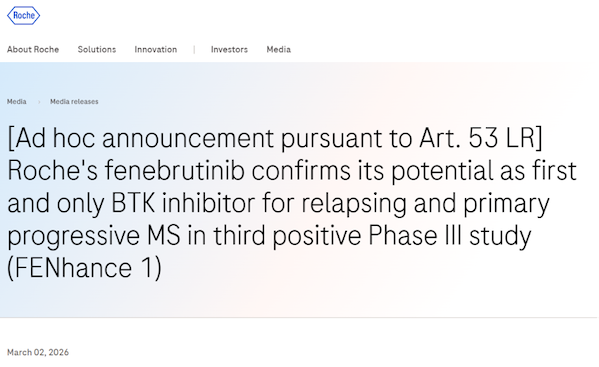 Image source: Roche official website
According to information disclosed by Roche, in patients with relapsing multiple sclerosis (RMS), fenetinib significantly reduced the annual relapse rate (ARR) by 51% compared to teriflunomide, with a treatment duration of at least 96 weeks. This result echoes the 59% ARR reduction reported in the previous FENhance 2 study; Roche even provided a striking conversion: the two studies combined roughly equate to "one relapse every 17 years." Multiple sclerosis (MS) is a chronic autoimmune disease in which the patient's immune system mistakenly attacks the myelin sheath of the central nervous system (brain and spinal cord), leading to inflammation, demyelination, and impaired nerve signal transmission. Common symptoms include blurred vision, numbness and weakness in the limbs, extreme fatigue, balance disorders, and cognitive impairment, which can cause permanent disability in severe cases.
For a long time, the treatment landscape for MS has been dominated by disease-modifying therapies (DMTs). Early treatments relied on injectable drugs such as interferon and gliclazide acetate. Later, oral medications like teriflunomide, fingolimod, and sinimod became more widespread. Highly effective monoclonal antibodies, such as Roche's Ocrevus, became the gold standard for RMS and PPMS. However, these drugs are mostly administered intravenously or subcutaneously, requiring patients to visit the hospital monthly or every six months, making adherence a major issue. The biggest advantage of fenebrutinib is that it is an oral formulation that can effectively cross the blood-brain barrier, inhibiting not only peripheral B cells but also directly reaching the central nervous system, simultaneously addressing both RMS and PPMS. For the MS field, long dominated by injectable drugs and monoclonal antibodies, this is undoubtedly a blockbuster. Roche's Chief Medical Officer, Levi Garraway, stated, "These positive results further confirm the potential of fenebrutinib, and Roche plans to submit a marketing application to regulatory agencies as soon as possible." Complete data on fenebrutinib will also be presented at the 2026 American Academy of Neurology (AAN) Annual Meeting.
https://news.yaozh.com/archive/47342.html
By editor
Copyright©2026 Ddu. All rights reserved.
Read more on
- CPHI Milan 2026 Recap | What Did Drugdu.com Bring Back from Milan? October 9, 2026
- Novo Nordisk and Nanexa Ink Up to €1.165B Long-Acting Delivery Deal for Obesity and Diabetes September 29, 2026
- siRNA Biotech ADARx Raises $446M in 2026’s Third-Largest Biotech IPO September 29, 2026
- Merck and Eisai’s Welireg Plus Lenvima Approved by FDA for Previously Treated Advanced Kidney Cancer September 29, 2026
- Mirum and Incyte’s Atebrioz Wins FDA Approval for Rare Bone Disorder FOP September 29, 2026
your submission has already been received.
OK
Subscribe
Please enter a valid Email address!
Submit
The most relevant industry news & insight will be sent to you every two weeks.


