
A new generation of ophthalmic dual antibodies challenges Roche’s dominant position.
January 23, 2026
Source: drugdu
 329
329
Ollin recently released early data on its VEGF/Ang2 bispecific antibody OLN324 against Roche's blockbuster product Vabysmo.
The results showed that nearly 90% of patients with diabetic macular edema (DME) achieved lesion resolution within 12 weeks , while Roche's Vabysmo only achieved 57% in the same metric. This means that the drug has the potential to cause lesion reversal and revolutionize the treatment of retinal diseases.
01
Head-to-head challenge against Roche's pharmaceutical giant
head-to-head phase 1b clinical trial conducted in multiple centers in the United States . It enrolled more than 160 patients with wet age-related macular degeneration (wAMD) or diabetic macular edema (DME) and compared the efficacy and safety of IBI324 with Vabysmo (faricimab).
Results showed that at week 12, nearly 90% of patients with DME treated with OLN324 4 mg achieved DME elimination (defined as central retinal thickness CST < 325 μm), compared to 57% in the faricimab group .
In terms of retinal fluid resolution , OLN324 also showed a faster and more significant effect compared to faricimab . Based on optical coherence tomography (OCT) measurements, at week 12, patients with DME treated with OLN324 4 mg showed a CST reduction that was approximately 50% greater than that of faricimab (−180 μm vs. −121 μm).
Furthermore, in wAMD patients, OLN324 achieved anatomical improvements consistent with controls, with OCT showing a rapid decrease in CST at week 1 and continued improvement until week 12. Rapid and sustained improvement in best-corrected visual acuity (BCVA) was observed in all treatment groups.
Furthermore, in both the DME and wAMD indications, OLN324 showed numerically superior visual improvement at week 12 compared to faricimab.
In terms of safety, OLN324 demonstrated a favorable safety profile. No cases of intraocular inflammation were reported in either of the investigational drug treatment groups, while one case was reported in the faricimab group. No cases of retinal vasculitis were reported.
These data validate the BIC potential of OLN324, making it the first and currently the only therapy to challenge market leader faricimab in a head-to-head, randomized clinical trial and demonstrate superior efficacy.
02
China's strength
VEGF (vascular endothelial growth factor) has long been a core target for the treatment of ophthalmic diseases. Over the past decade, anti-VEGF monoclonal antibodies such as aflibercept and ranibizumab have dominated the market for the treatment of retinal diseases.
However, while these drugs are effective, they also have significant limitations. Patients require frequent injections, and some experience diminishing returns after long-term anti-VEGF treatment. This has led researchers to realize that single-target strategies often have limited efficacy for complex diseases.
Therefore, bispecific antibodies, represented by Vabysmo (targeting VEGF/Ang2), have emerged. By simultaneously inhibiting VEGF and Ang2, they can not only more effectively block leakage but also enhance vascular stability and reduce inflammation, thereby achieving deeper and more lasting lesion elimination and significantly prolonging the injection interval.
Faricimab was the first VEGF/Ang2 inhibitor approved by the US FDA and has become a major growth engine for Roche since its launch in 2022. Its sales reached $4.4 billion in 2024, and in the first three quarters of 2025, it had already reached $3.9 billion, with full-year sales projected to exceed $5 billion.
It is worth mentioning that the original innovation of OLN324 comes from the Chinese pharmaceutical company Innovent Biologics .
Last September, Ollin completed its initial $100 million funding round, emerging from obscurity and into the public eye. The company's CEO and co-founder, Dr. Jason Ehrlich, previously worked at Roche Genentech and participated in the development of faricimab. Based on this background, Ollin focuses on the field of ophthalmic diseases and is determined to challenge faricimab's market position.
Through a collaborative acquisition model, it obtained ophthalmic drug candidates OLN324 and OLN102 from two Chinese pharmaceutical companies, Innovent Biologics and Orange Sail Pharmaceuticals, respectively.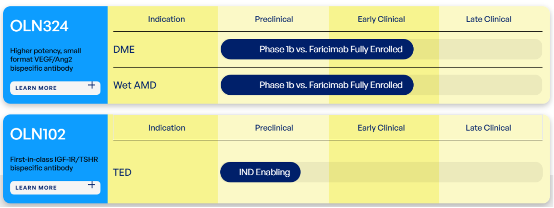 Currently, OLN324 (IBI324) is its only clinical-stage project.
This drug is a new generation of VEGF/Ang2 bispecific antibody that has been further optimized and designed based on existing VEGF/Ang2 bispecific antibodies.
The early clinical data released this time validates its BIC potential, possibly because OLN324 has higher anti-Ang2 activity and a smaller molecular size, which means it can penetrate deeper into tissues more easily after injection and can achieve higher molar doses .
Dr. Jason Ehrlich stated that Ollin will expedite the global Phase 3 clinical trial of OLN324 for the two indications of DME and wAMD.
Besides Innovent Biologics, many other Chinese pharmaceutical companies are also accelerating their expansion in the field of dual/multi-target ophthalmic drugs.
The VEGF/ANG-2 bispecific antibody ASKG712, originally developed by AskGene, a subsidiary of Ausun Pharmaceuticals , is in Phase 2 clinical trials.
In 2022, Auscon granted exclusive rights to develop, manufacture, and commercialize ASKG712 in regions outside Asia and in the Japanese market to AffaMed. In October 2025, Auscon further granted exclusive rights to ASKG712 in Greater China, Singapore, Thailand, Malaysia, Indonesia, Vietnam, South Korea, and India to Visara, a subsidiary of Newbridge Biotech. Shortly afterward, Visara transferred exclusive rights to VIS-101 in Greater China and some Asian countries to Everest Medicines.
Kangzhe Pharmaceutical /Youzhiyou's Y400, a quadrivalent bispecific antibody targeting VEGF and ANG2, is currently in Phase 1/2 clinical trials. This drug utilizes a unique nanobody design, offering advantages such as high affinity, strong inhibitory activity, high formulation concentration, good stability, and low dosing frequency.
Xingmou Biotech 's AAV gene therapy drug XMVA09, targeting VEGF/Ang2, has initiated a Phase 2 clinical trial for the treatment of wAMD. This drug, administered via intravitreal injection, acts directly on RPE cells to express therapeutic proteins, potentially achieving long-term therapeutic effects for wAMD.
In addition, Innovent Biologics also has a VEGF/complement receptor fusion protein emovopeptide injection (IBI302), which exerts its therapeutic effect by simultaneously inhibiting VEGF-mediated angiogenesis and complement activation pathways. This drug is currently undergoing multiple clinical trials for AMD and DME.
Rongchang Biotech 's VEGF/FGF dual-target fusion protein drug RC28-E has been submitted for new drug application in China for the treatment of diabetic macular edema (DME). Additionally, the drug's indication for wet age-related macular degeneration (wAMD) is expected to be submitted for marketing application in China by mid-2026.
by Octogen, showed potential to maintain efficacy for up to 12 weeks with a single injection in a Phase I study. The drug is currently undergoing Phase II clinical trials in both China and the United States.
03
Conclusion
These drug candidates indicate that the treatment of retinal diseases is moving into a new phase aimed at "better anatomy and visual improvement, and longer treatment intervals".
Chinese pharmaceutical companies have become an indispensable force in global ophthalmic innovation and research. Through cooperation with international capital, they are creating new possibilities for the development of next-generation ophthalmic therapies.
https://news.yaozh.com/archive/46970.html
By editor
Copyright©2026 Ddu. All rights reserved.
Read more on
- The snoring of 1 billion people can finally be cured! The FDA has accepted the marketing application for a new oral drug for obstructive sleep apnea. September 3, 2026
- Biosimilar Export Accelerates! Jianyou’s Adalimumab Receives FDA Approval for Additional Manufacturing Site | Overseas Expansion News September 3, 2026
- Beyond Glycemic Control! Lilly’s Tirzepatide Receives FDA Approval for Cardiovascular Risk Reduction | Approval Alert September 3, 2026
- First New Therapy in Nearly 30 Years! FDA Approves Besremi for Essential Thrombocythemia | Approval Alert September 3, 2026
- Filling Domestic Gap! Hengrui’s First Long-Acting Insulin Ruihengying® Launches Online on Sept 1 | Industry News September 3, 2026
your submission has already been received.
OK
Subscribe
Please enter a valid Email address!
Submit
The most relevant industry news & insight will be sent to you every two weeks.


