
The leading medical device company’s new venture is aiming for an IPO!
December 25, 2025
Source: drugdu
 235
235
According to recent foreign media reports, Medtronic, the world's leading medical device company, has entered a critical stage in a major strategic initiative. Medtronic announced that its diabetes business, MiniMed, has filed for an initial public offering (IPO) with the U.S. Securities and Exchange Commission (SEC).
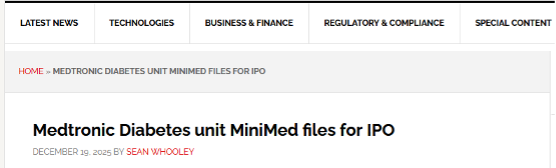 Image source: Latest Medical Device News on MassDevice
01
Stripping and splitting
Listed on Nasdaq
On May 21 this year, Medtronic officially announced its plan to spin off its diabetes business into a new independent publicly traded company, MiniMed, and made it clear that it would prioritize completing this process through an initial public offering (IPO) and subsequent equity divestiture, with all work expected to be completed within the next 18 months.
Recently, with Medtronic's official announcement, this business divestiture process has made substantial progress. MiniMed plans to list on the Nasdaq Stock Exchange under the ticker symbol "MMED," aiming to raise no more than $100 million through the IPO .
According to publicly available information, in the six months ending October 24, 2025, MiniMed achieved net sales of $1.48 billion and a net loss of $21 million , representing a slight narrowing of losses while revenue increased in the same period of the previous year. However, it's worth noting that the diabetes business is not a persistent negative growth burden for Medtronic; Medtronic's spin-off stems more from a strategic focus and optimization of its business portfolio.
According to Medtronic's fiscal year 2025 financial report, the diabetes business contributed $2.75 billion in sales to Medtronic , achieving a 10.7% growth. While this business segment continued its growth trend, its overall impact on total revenue was relatively small, accounting for 8% of total revenue and 4% of operating profit .
Therefore, the spin-off of the diabetes business is more like a well-planned strategic move by Medtronic after combining its own business portfolio and long-term growth logic, and reviewing the global medical device market landscape.
On the one hand, from MiniMed's perspective, its product pipeline is relatively mature, and its core product, the MiniMed 780G automated insulin delivery system , received two key FDA approvals in September of this year, significantly enhancing its product competitiveness. Through the spin-off, MiniMed can gain an independent capital platform and operational flexibility, allowing it to focus more intently on addressing the intense market competition and innovation demands in the diabetes field.
On the other hand, Medtronic will be able to concentrate its resources more on core sectors with greater competitive advantages and higher profit margins, such as cardiovascular and neuroscience. Following the spin-off, Medtronic expects its overall adjusted gross margin and operating profit margin to increase by 50 and 100 basis points, respectively.
The global diabetes market is expanding rapidly along with the growing patient population. According to publicly available data, the global diabetes market size reached US$88.32 billion in 2024 and is expected to exceed US$100 billion in 2025. However, with many companies entering the diabetes market, competition is fierce, and MiniMed will face pressure from companies like Abbott.
02
Strategic Continuation
Accelerate product layout
The spin-off of the diabetes business is a continuation of Medtronic's streamlining strategy in recent years. In 2023, Medtronic spun off its kidney care business and formed a joint venture, Mozarc Medical, with DaVita, and exited the ventilator market in 2024. All these moves point to the same goal: streamlining the business portfolio, exiting areas with sluggish growth or non-core functions, and concentrating management resources and capital on the most competitive and profitable sectors.
Following the spin-off, Medtronic's business will focus on three main segments: cardiovascular, neuroscience, and medical surgery . Medtronic's Q2 FY2026 financial results, released in November, showed strong growth momentum across all three segments.
The cardiovascular business continued to lead the way, with revenue of $3.436 billion, a year-on-year increase of 10.8% , marking its strongest performance in over a decade, excluding the impact of the pandemic. Among them, Cardiac Ablation Solutions saw a surge in revenue of 71% year-on-year. In addition, the neuroscience business generated $2.562 billion in revenue, up 4.5%; and the medical surgery business generated $2.171 billion in revenue, up 2.1%.
Furthermore, Medtronic's products continued to make breakthroughs in 2025. According to data from PharmNet Medical Devices, Medtronic currently has 7,888 products on the market in the United States and 377 products on the market in China . As one of the largest markets in the medical device industry, China has attracted major global medical device companies to continuously increase their investment. Medtronic also has more and more innovative products being approved in China, such as the SmartSync™ flat panel programmer, Profile 3D™ valve repair ring, Cardioblate CryoFlex™ surgical cryoablation system, and Sonicision™ ultrasonic scalpel.
In addition, products such as the Aurora EV-ICD™ extravascular implantable cardioverter defibrillator and the world's first "brain-computer interface" brain pacemaker, the Percept™ RC rechargeable deep brain stimulator, have begun to be used in clinical practice in China.
In the international market, Medtronic is also accelerating the development of several potential products. For example, the Hugo robotic-assisted surgical system officially received FDA approval on December 4th, with its first indication being urological surgery. Meanwhile, Medtronic is also making steady progress in its cardiovascular field, continuously expanding its advantages in the cardiovascular business.
03
Conclusion
Slimming down has become quite common among tech giants in recent years. This month, in addition to Medtronic, Terifor also announced a major decision to sell its three main business segments—emergency care, interventional urology, and OEM—for a total of $2.03 billion. Through these streamlining decisions, the company can more easily focus on its core competencies, where it has greater advantages, higher technological barriers, and stronger market control.
https://news.yaozh.com/archive/46744.html
By editor
Copyright©2026 Ddu. All rights reserved.
Read more on
- Novo Nordisk and Nanexa Ink Up to €1.165B Long-Acting Delivery Deal for Obesity and Diabetes September 29, 2026
- siRNA Biotech ADARx Raises $446M in 2026’s Third-Largest Biotech IPO September 29, 2026
- Merck and Eisai’s Welireg Plus Lenvima Approved by FDA for Previously Treated Advanced Kidney Cancer September 29, 2026
- Mirum and Incyte’s Atebrioz Wins FDA Approval for Rare Bone Disorder FOP September 29, 2026
- J&J in Talks to Sell DePuy Synthes to Apollo September 29, 2026
your submission has already been received.
OK
Subscribe
Please enter a valid Email address!
Submit
The most relevant industry news & insight will be sent to you every two weeks.


